Responsibility Chart for Kids: Jobs They Already Own
A responsibility chart for kids is pictures of jobs they own — not stars, not a conduct board. Age-right ownership, why paper dies, when a live sequence.
A child standing by the door at 7:42 a.m. does not have a character lesson. They have a parent listing the self they were supposed to already be.
“Did you pack your bag. Shoes. Did you feed the dog. Why is your toothbrush still dry. You are old enough to be responsible.” That is not a chart. That is a stream of language a working-memory system still under construction has to parse while also locating a shoe.
A responsibility chart for kids replaces the stream with pictures of jobs the child already owns. Backpack. Brush. Bowl. Hamper. Shoes. The child looks at the current picture, does that one job, marks it done, and the next picture becomes current. The parent stops being the proof of character.
This page is the operating system for the generic search: how a school-age child ages 4–12 runs a short strip of owned jobs so the house can see they finished without a speech. It is not a conduct scoreboard, not a sticker contest, and not the after-school chore player. Those pages exist and are linked below. This one is the strip that makes three owned jobs actually happen on a Tuesday.
This is a household organization guide. It is not occupational therapy, a diagnosis, or a treatment plan. Children with significant language, sensory, or motor needs may need individualized support beyond a picture ownership sequence — consult your child’s therapist if refusal or distress persists.
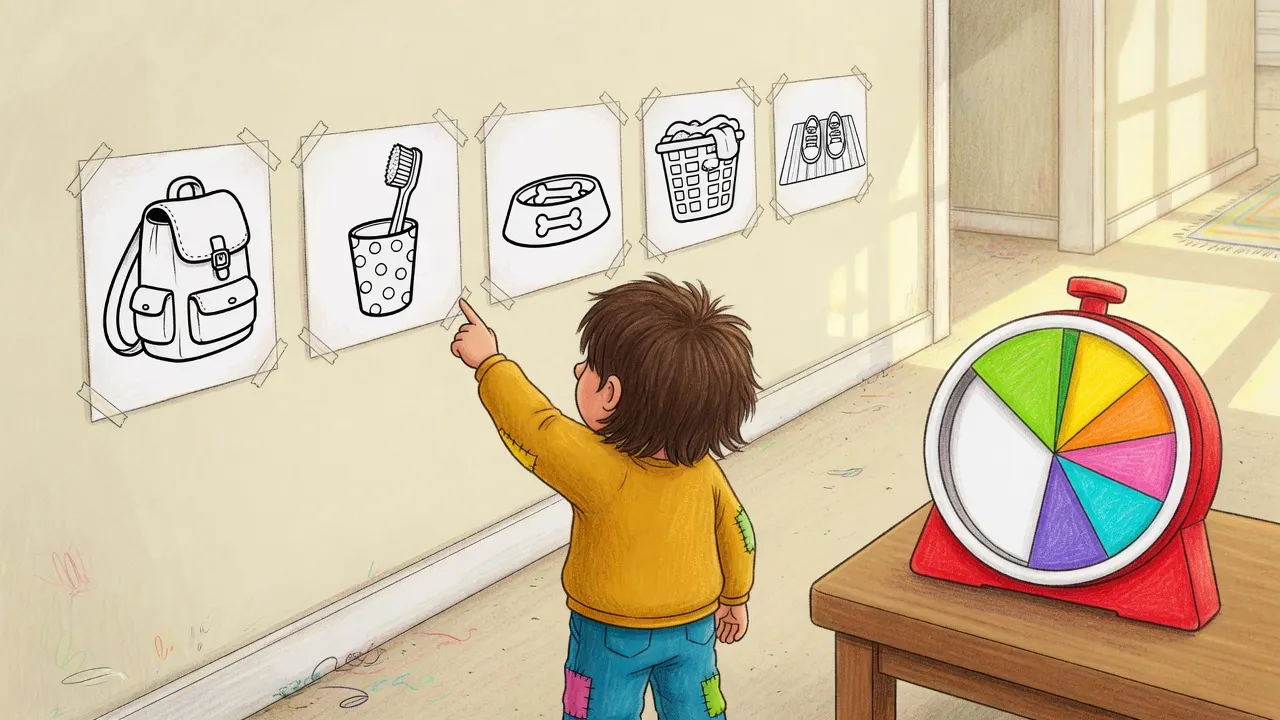
What a Responsibility Chart for Kids Is (and What It Is Not)
A responsibility chart for kids is a picture of each job the child is trusted to finish without being asked, in a fixed order, that the child can see without a parent announcing it. Each picture is one owned action. The order does not change because the parent is tired or the child negotiated. The current picture is the only instruction that matters.
That definition is narrower than most search results. “Responsibility chart” is used for weekly calendars, character-trait grids, sticker contests, classroom jobs, and fridge lists that mix “be kind” with “take out trash.” Mixing those jobs on one board is why so many first attempts become wallpaper in a week.
Not a chore chart
A chore chart for kids is the after-school (or after-dinner) job player: plate, bag, broom at one household anchor so the work of the house moves. A responsibility chart is the child’s owned domain. Packing their backpack is ownership. Clearing the family’s table after dinner is a chore. You can run both. Do not print one grid that pretends they are the same unit. Use the chore page to build the household job sequence. Use this page to name what this child is trusted to finish without a prompt.
Not a behavior chart
A behavior chart tracks hitting, yelling, or following a direction. Packing a backpack is not a temperament. Mixing “use kind words” with “shoes on the mat” trains the child to treat owned jobs as punishment, or to treat hitting as a household task they can bargain. Keep conduct on the behavior page.
Not a reward chart
A reward chart marks prizes. Stickers can sit next to a finished ownership picture. They should not be why the zipper closed. If the child will only pack the bag for a star, you built a vending machine, not a trusted job.
Not a chore list by age
A chore list for kids by age is content — what jobs exist at four, six, eight, ten. It answers “what is reasonable to ask.” A responsibility chart is a player. It answers “which three of those jobs does this child already own, in this order, before the door.” Keep the list for planning. Keep this page for the pictures that run.
Not a family chore chart
A family chore chart is one column per child so siblings can see who owns what and rotate without a fairness argument. This page is one child’s owned strip. When a second child needs a column, graduate the same pictures into columns. Do not start with a five-column grid because a template looked official.
Not a visual schedule, and not a routine chart
A visual schedule for kids runs the sequence of the day-part. A routine chart for kids holds morning or bedtime as a day-part. A responsibility chart hangs inside one of those slots — usually the last morning pictures before the door, or the first after-school pictures after snack. Mixing “this is how our morning works” with “this is what you own” on one poster trains the child to treat toothbrushing as optional labor. Keep the schedule for the day-part. Keep this strip for the jobs that prove ownership.
Not allowance, and not photo proof
RoutinePals does not track money. TaskTroll is the companion product for school-age allowance and family task tracking. Keep payroll off the ownership strip. Photo verification is not a TaskTroll feature. Co-parenting is ParentDocket, not TaskTroll. Second adults on TaskTroll join as family members.
Not a first-then board, and not a timer
A first-then board is two pictures: first bag, then door. Use it when the fight is a single pair. A visual timer is a picture of how long this owned job lasts. Pair a timer with the picture that stalls. Neither tool is the chart. They stack onto it.
Why Word Grids and Character Posters Fail
Adults have automated self-care and household jobs. Children have not. Each verbal reminder asks the child to (1) notice they were spoken to, (2) parse the sentence, (3) map it onto a physical action, (4) start, and (5) remember what comes after. That is five jobs. A picture on the wall is already job 2 and job 5, sitting there with no tone.
Three failure modes show up in almost every household still using a printed “responsibility” grid:
The chart is a list of traits, not jobs. “Be responsible / be kind / be a helper” cannot be marked done. A five-year-old cannot match “be responsible” to a room. A drawing of a closed backpack can. If you cannot photograph the finished state, it does not belong on this strip.
The child can read the grid and still does not start. “Pack bag / feed dog / put shoes away” is an adult checklist hung at kid height. A five-year-old who can sound out “bag” still has to convert the word into a zipper, a lunch box, a folder, and a hook. A drawing of a closed backpack is already the bag.
Reset is a parent job, so the system dies in week two. Paper and magnets only work if someone flips them back every morning. If that someone is the parent who is also packing a lunch, the chart is already competing with the door. A live sequence resets itself.
A word grid can still be your planning tool. It is a bad player for the child.
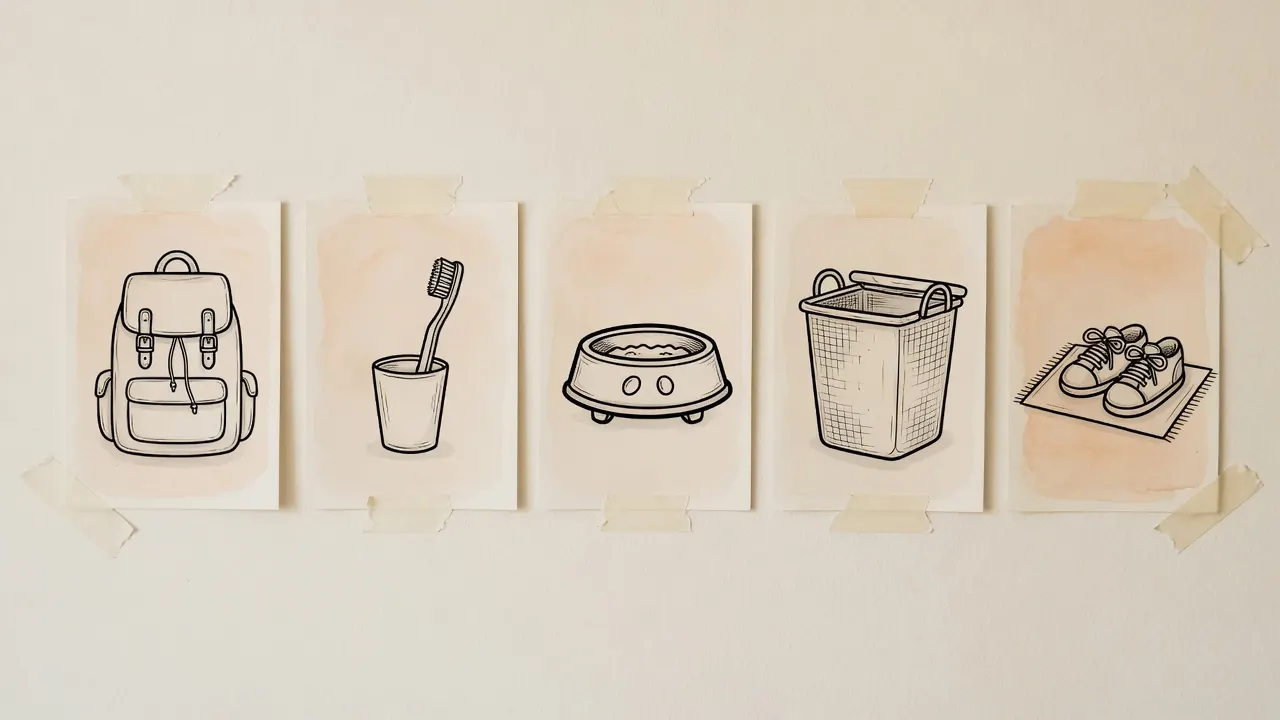
Age-Right Jobs This Chart Can Own
Match the picture to a body that can finish it. The chore list by age is the catalog. Below is what belongs on this player’s three-to-five picture strip — jobs the child is trusted to finish, not a personality score.
Ages 4–5
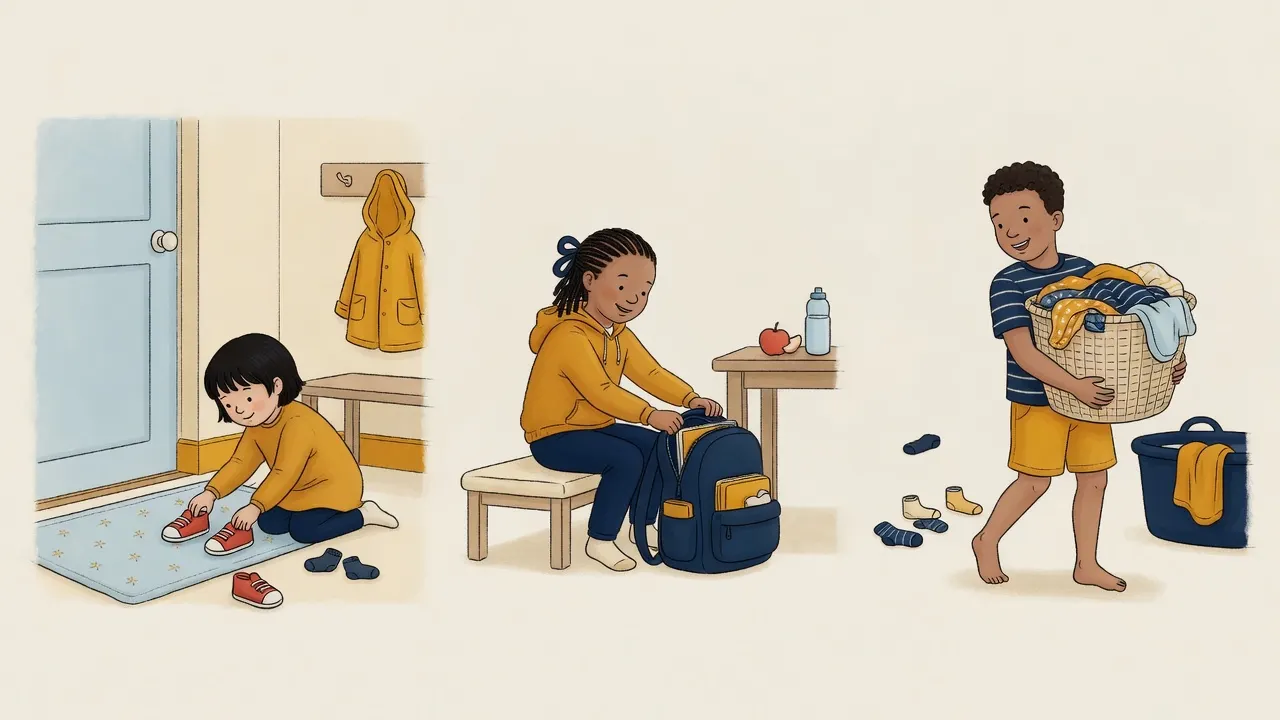
Two or three one-step owned jobs. Shoes on the mat. Dirty clothes in the hamper you already opened. A measured scoop of pet food if the bin is light and the bowl is on the floor. A toothbrush standing in a cup after you still help with the brushing itself — the picture is the cup, not the two-minute technique.
Done means the object moved to the place in the picture. You may still tie the shoe. Name it done when the child’s part is finished. If you redo the hamper in front of them while sighing, you taught them the picture was a joke.
Scope: one daily slot. Last pictures before the door, or first pictures after snack. Not both until three pictures are easy for a week.
Ages 6–9
Three to five owned jobs with a visible done-state. Pack the backpack from a labeled shelf — that job has its own close-up on the packing backpack page if it stalls. Toothbrush in the cup after the last brush. Feed the pet. Put a folded stack into a labeled drawer. Carry a snack plate to the sink.
This is the age where text labels sneak back onto the wall because the child can read. Resist that for the job pictures. Reading the word “backpack” is slower than seeing the backpack, and it reintroduces the language load you removed. Use a visual timer on the one job that stalls — usually packing — not on every picture.
Scope: one slot, five pictures max. Parent checks at the end, not at each picture.
Ages 10–12
Same count, more trust. Start their own laundry load (you still measure soap if that is a chemical). Pack tomorrow’s lunch pieces from a labeled shelf. Take trash they filled all the way out. Wipe their bathroom sink. Put tomorrow’s clothes on a chair the night before.
A ten-year-old who “doesn’t need pictures” often still needs them for the one morning that blows up. Shrinking the chart to the two jobs that actually fail is allowed. Dropping the system because it feels babyish, then returning to hallway yelling, is not an upgrade. Let the child help choose the pictures. Do not let the child delete the strip because a friend does not have one.
Scope: child-initiated start on the slot; parent verifies completion, not effort.
How to Build the Ownership Strip
1. Pick one daily slot. Last pictures before the door, or first pictures after snack. Write the time as a picture, not a clock argument: backpack on the hook, apple on a plate, then the owned pictures begin. A morning routine or after-school routine can hold the day-part; this chart holds the jobs inside the slot that prove “this is yours.” If the slot floats, the jobs float, and you are back to a list.
2. Pick three jobs the house can see are finished. Not “be responsible.” Not “clean your room” as a blob — that is its own clean room routine. Not toy pickup as the whole board — that is a putting away toys sequence. Choose objects: backpack, cup, bowl, hamper, shoes.
3. Draw the completed state. The backpack is closed and on the hook, not mid-zip. The toothbrush is in the cup, not mid-brush. The pet bowl has food in it. Children match the picture to the room. A mid-action drawing leaves “done” negotiable.
4. Hang the pictures at the child’s eyes in the room the first owned job starts. Hall for shoes and backpack. Kitchen for bowl and plate. Bathroom for the cup. Do not hang them in a home-office where the jobs do not happen.
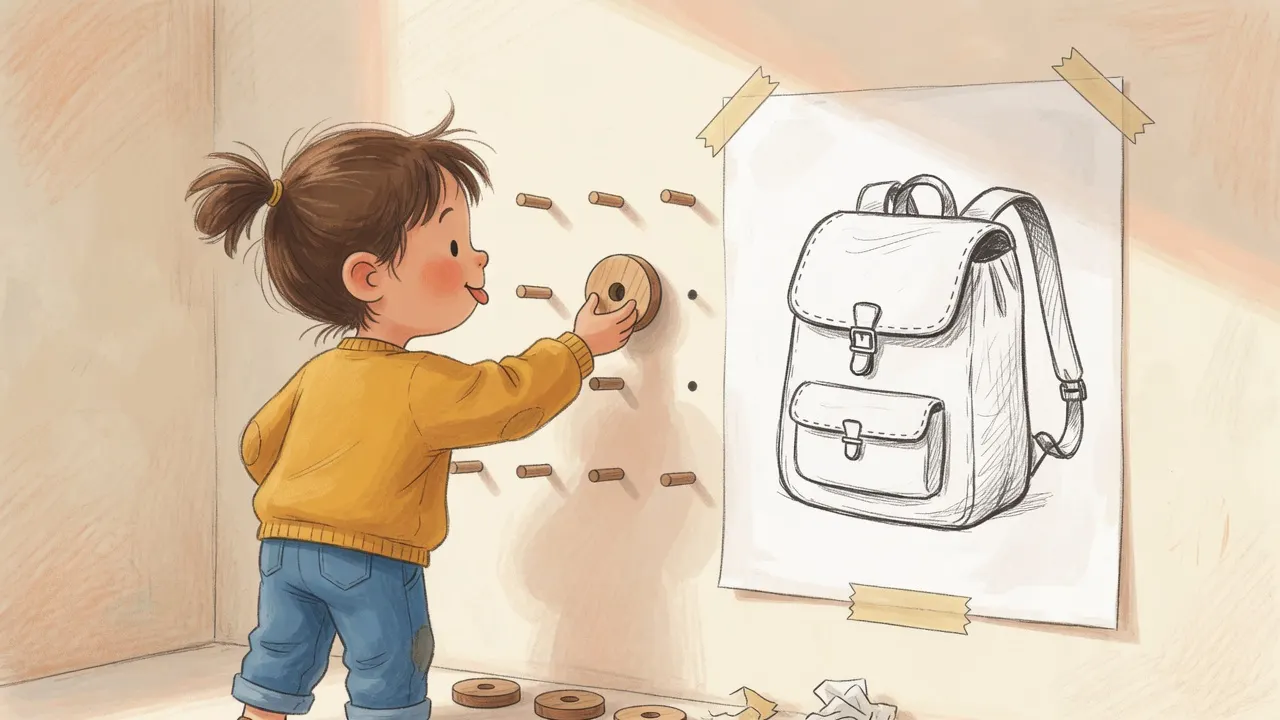
5. Give the child a way to mark done that does not require you. A wooden disk on a peg. A flip. A move-to-done column. A tap on a live sequence. If marking done requires a parent with a pen, the parent is still the chart.
6. Model for four days. Doorway for the next four. End-check after that. Narrating every picture teaches the child to wait for your voice. Point at the wall if they look at you. Do not add a sentence. Do not add a lecture about character.
7. Do not rotate in week one. Rotation is a family chore chart problem. A single-child ownership strip needs two weeks of the same three pictures before you swap one.
A Worked Tuesday: Three Pictures Before the Door
Here is a chart that fits a real 7:35 a.m. hallway. It is not a template to photocopy. It is a proof that three owned pictures beat a ten-row character grid.
Slot pictures the child already understands: lights on, clothes on. Those are not this strip. They are the door into the ownership sequence, and they belong on the morning routine page. If clothes never land, the owned jobs never start. Fix the landing with the morning page; do not add more ownership pictures to a child who is still in pajamas.
Job 1 — backpack. The drawing is a closed backpack on a hook, not a child mid-pack. The child puts folder, lunch, and water bottle in, closes it, hangs it, marks done. If packing is the stall every day, send that job to the packing backpack routine and leave one card on this strip that means “that routine already ran.”
Job 2 — cup. The drawing is a toothbrush standing in a cup. The child brushes (you may still time it) and parks the brush. Marks done at the cup, not at the sink foam.
Job 3 — shoes. The drawing is shoes on the mat by the door. The child puts them on and marks done. You may still tie. The picture is ownership of the move, not of the double knot.
That is the whole Tuesday morning ownership strip. No laundry. No “be a helper.” Three objects in their finished place. The house can see the child ran their jobs. If you want a fourth picture in week three, add the pet bowl — not “be responsible,” not the whole Saturday deep-clean.
Siblings who are not on this chart yet should not be graded against it. “Your sister packed her bag” is a column problem. Open the family chore chart when you are ready to make that comparison visible and fair. Until then, this strip belongs to one child.
Weekday Strip, Saturday Strip
A responsibility chart for kids that tries to hold Tuesday door jobs and Saturday laundry on one board will lose Tuesday. The weekday strip is three to five pictures at one slot. Saturday is a different sequence — clean room, putting away toys, maybe a bathroom wipe — and it needs its own short strip or its own Kid Mode routine.
Do not print a weekly calendar with Monday-through-Sunday cells for a child who cannot yet run three pictures on a school day. Weekly grids are adult planning. They look like a chart and behave like a homework packet. When weekday pictures are easy for two weeks, then build Saturday as a second sequence with the same rules: completed-state pictures, one start signal, a mark for done.
Weekend mornings are a different day-part. Do not retitle this chart as a family calendar. A calendar answers “what kind of day is this.” A responsibility chart answers “which owned job is current.”
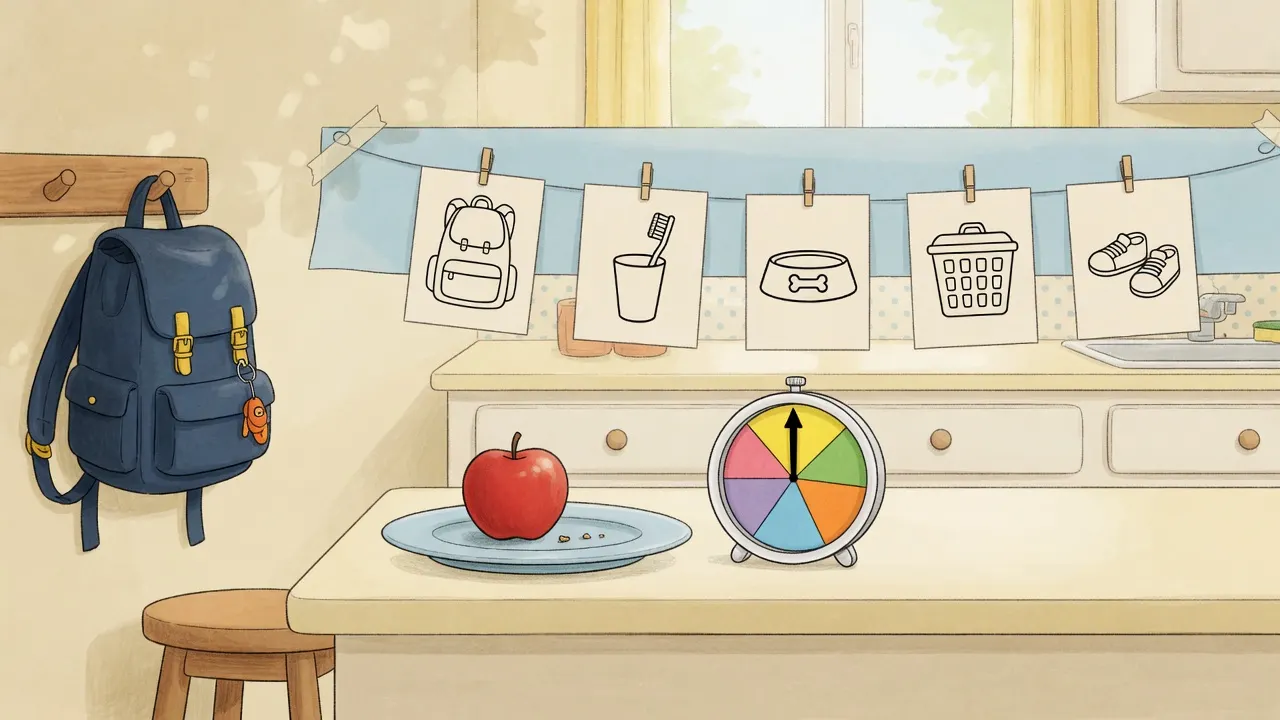
Printable, Magnets, or a Live Sequence
All three can be a responsibility chart for kids. They fail in different ways.
Paper on the wall. Fastest to start tonight. Fails when it tears, gets steam-warped, or lives at adult height. Reset is manual.
Magnets on the fridge. Satisfying completion move. Fails when magnets fall, get eaten by a toddler sibling, or the fridge is not in the room the jobs use. Also fails as wallpaper: a fridge full of pictures becomes noise.
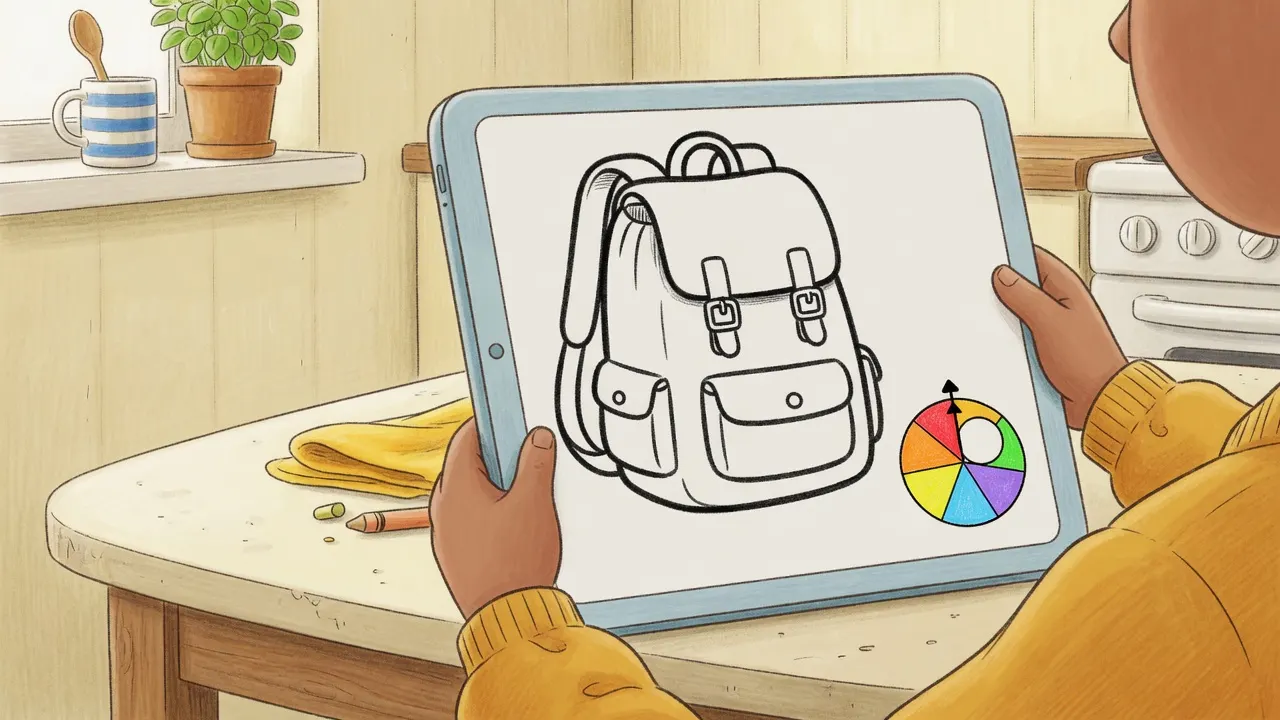
Live picture sequence. One large picture at a time, auto-reset, optional countdown on the stall job, completion that does not require a magnet to stay stuck. Fails if the parent never builds the sequence, if the pictures are clip-art the child does not recognize, or if the phone is also the game device and the chart becomes a negotiation for screen time. Keep the job device distinct from the reward device when you can.
The test is not which medium is virtuous. The test is: after ten days, is the child looking at the current picture without being told, and do the jobs still match the house? If paper is still standing and the child is using it, keep paper. If you have reset the magnets yourself eight mornings in a row, the medium is the parent.
A longer app-versus-printable comparison sits on the best chore chart app guide (TaskTroll’s allowance and family-task side). The short version for this operating system: paper to learn which jobs they own, live pictures to keep the ownership running, money in a different product.
When the Chart Breaks
Most responsibility charts for kids break between days eight and fourteen. Novelty is gone. Automaticity is not in yet. The child tests whether the wall still has authority.
The pictures do not match the house. You posted a sit-down packed lunch. You actually hand them a sandwich at the door. The child correctly ignores the lunch picture. Fix the picture. Do not lecture integrity.
The strip is a character poster. “Be responsible” cannot be marked done. Cut it. Put three objects back.
The strip is too long. Seven jobs for a six-year-old is a catalog. Cut to three. You can grow later.
The parent is still the chart. If you narrate every picture, the child learns to wait for your voice. Stand in the doorway.
Two systems disagree. Fridge magnets say shoes then bag. The app says bag then shoes. The child is not non-compliant. The house has two authorities. Pick one order. Put it in one place.
The stall is a skill, not a chart problem. If the stall is always “pack your bag,” this chart cannot teach sorting a folder. Send that job to its own routine — packing backpack, clean room, putting away toys — and leave one card on the main strip that means “that routine already ran.”
ADHD and time-blind mornings. Fewer pictures, a disk on the stall, the same slot every day. The ADHD routine for kids page is the close-up. Do not respond to a time-blind Tuesday by adding more owned jobs.
You mixed hitting with the backpack. Split it. Conduct belongs on the behavior chart. Prizes belong on the reward chart. Household after-school jobs belong on the chore chart. This strip is ownership only.
A second child arrives. Do not squeeze two names onto one strip. Graduate to the family chore chart.
You added stars, then money, then a speech about character. The pictures lost authority. Strip the extras. Put stars on a separate reward chart if you still want them. Put money in TaskTroll. Put the speech away.
How RoutinePals Holds the Ownership Sequence
RoutinePals is built for this exact job: picture sequences a child runs in Kid Mode without a parent announcing each next step.
A parent builds the owned jobs as one routine. Each step is one large unlabeled picture. The child taps the picture when the job is done and the next picture fills the screen. A visual countdown can sit on the job that stalls — five minutes on packing, two on shoes — without putting a clock on every card. The parent dashboard shows which sequence ran and which picture was last completed.
That is the difference from a fridge wall. The current picture is large. The other pictures are not competing. The sequence resets tomorrow without a parent flipping magnets before the door.
Registration seeds two starter routines and leaves a third slot you pick from 40 activity templates. That is the permanent free floor: 1 child, 3 routines total, 3 characters. Use the two starters as morning and bedtime if those are your fires, and spend the third slot on this ownership sequence. Pro at $6.99/month or $49.99/year unlocks the custom builder and unlimited children, routines, and characters.
The first-then board page is the on-ramp if two pictures are all the child can hold. The visual timer page is the duration tool you drop onto one job. The chore chart for kids page is the household job player at a different anchor. The behavior chart page is conduct. The reward chart page is prizes. The chore list by age page is the catalog. This page is the player that runs three owned jobs so the child is not learning a poster of a better personality.
RoutinePals does not do allowance, photo proof of chores, or two-household custody tools. Those are different products.
A 14-Day Rollout That Fits a Real House
Days 1–2. Pick before the door or after snack. Three pictures, eye height, parent in the room. Same time both days.
Days 3–7. Parent moves to the doorway. Child marks done. Do not add a fourth picture. Do not change pictures unless a picture is factually wrong. Do not add a speech about character.
Days 8–10. Expect a test. Hold the order. If one picture is the stall, shrink it or split it into its own routine. Do not add stickers to “save” a sequence the child does not yet understand.
Days 11–14. If the three pictures run four days with doorway-only support, add a fourth or build the inner routine for the stall card. Keep the first sequence running. Do not rebuild it to match a template you found at 11 p.m.
Week 3+. Fifth picture, or a second child column, or move paper to a live sequence when you are tired of resetting magnets — not as a personality upgrade.
A responsibility chart for kids is not a poster of a better child. It is a picture of the next job they already own, in a fixed order, at the child’s height, with a way to mark done. Build one slot. Match the pictures to the house that exists. Model it until the wall has authority. Add siblings, stars, and money only after the pictures already run.
For families who want those owned jobs as live Kid Mode picture routines — one large unlabeled picture per step, tap to complete, optional countdown on the stall — RoutinePals is available with a permanent free tier (1 child, 3 routines including 1 from 40 templates, 3 characters) and Pro at $6.99/month or $49.99/year.
Frequently Asked Questions
What is a responsibility chart for kids?
How is a responsibility chart different from a chore chart, a behavior chart, or a reward chart?
What should be on a responsibility chart for a 5 year old or an 8 year old?
Should a responsibility chart include stickers, stars, or allowance?
Does a printable responsibility chart for kids actually work?
How many responsibilities should a kid have on the chart?
How can RoutinePals help with a responsibility chart for kids?
RoutinePals — Visual Routines for Kids
Turn this routine into pictures your child can follow
Picture-based routines, visual timers, personalized storybook characters, and wake-up alarms in your own voice. Free tier includes 1 child, 3 ready-made routines, 3 characters, and 40 templates — no credit card needed. Pro unlocks everything at $6.99/mo or $49.99/yr.
Try RoutinePals FreeRelated Visual Routine Checklists
Reward Chart for Kids: A Parent's Complete Guide
A practical guide to reward charts for kids — how they work, which mistakes to avoid, and why a digital visual reward app like RoutinePals outperforms.
Routine Chart for Kids: The Parent's Complete Guide
Everything parents need to know about routine charts for kids — visual, printable, and digital options, age-by-age schedules, and how to build one that.
School Morning Routine for Kids: Stress-Free Timeline
Build a calmer school morning routine for kids with age-based checklists, sample schedules, backpack prep, breakfast timing, and visual routine tips.
Screen Time Schedule for Kids: What Actually Works
Build a screen time schedule for kids that sticks — age-by-age limits, when to allow devices, and how to use a routine app to enforce the rules automatically.