Tracking Symptoms in Toddlers Who Can't Yet Describe Them
Pre-verbal and barely-verbal toddlers can't tell you their ear hurts. Here's the observable-behavior framework parents use to translate toddler distress.
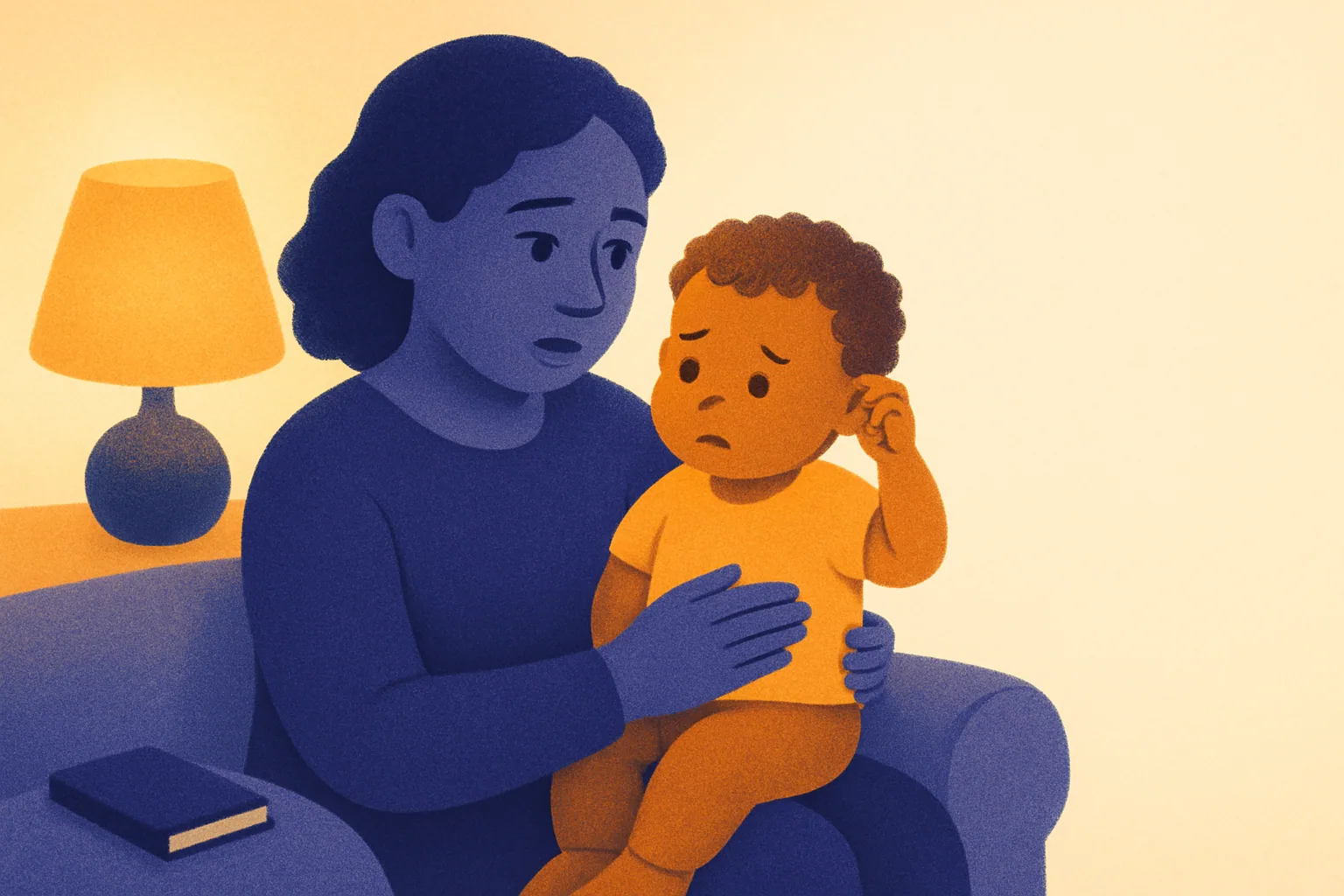
A 16-month-old can’t tell you their ear hurts. They can’t say “it’s the left one,” or “it started after my nap,” or “it’s worse when I lie down.” What they can do is show you — and that showing is rarely a single dramatic gesture. It’s a constellation of small things: crying when you lay them down for a bottle, batting at one side of their head, fussing through a feeding they normally inhale, waking three times in a night they usually sleep through.
The job of a parent in this stage is, essentially, translation. Your toddler is generating a stream of behavioral signal about what’s wrong, and the pediatrician on the other end of the phone needs that signal converted into a coherent set of observations they can work from. “She seems off” is a starting point, but it’s not enough on its own. “She’s been pulling at her left ear since yesterday morning, temperature crept from 99.8 at lunch to 101.2 at bedtime, and she refused both dinner and her bedtime bottle” — that’s a sentence a doctor can actually use.
This is one of the most invisible, mentally demanding tasks of toddler parenting. You’re holding a worried child, running a household, and simultaneously trying to remember whether the ear-pulling started Sunday or Monday. The framework below is meant to make that translation easier, not to substitute for a pediatrician’s judgment.
The behavior-as-symptom translation
Below are common observable behaviors in pre-verbal and barely-verbal toddlers, and what parents often notice before a pediatrician makes any kind of determination. None of this is diagnostic — these are patterns parents describe in retrospect, after the doctor has done the actual evaluating. The point of the list is to help you see what you’re seeing, not to label it.
Pulling at one ear, crying when lying flat, sleep disrupted on one side. Parents often observe this before an ear infection is diagnosed. Pressure changes when laying down can amplify ear discomfort, which is why a toddler may suddenly refuse a bottle in your arms or wake within minutes of being put down.
Refusing food, drooling more than usual, increased fussiness around eating. Parents often observe this before a throat-related issue — strep, hand-foot-mouth, or sometimes just teething — is sorted out by a pediatrician. The doctor distinguishes between these; a parent’s job is to describe what eating looks like now versus a week ago.
Pulling knees to chest, crying during or after feedings, straining. Often associated with GI discomfort in parent descriptions. Whether it’s gas, constipation, reflux, or something else is the pediatrician’s call.
Limping or favoring one leg. Sudden-onset limping in a toddler is something pediatricians generally want to evaluate the same day. It’s worth a call rather than a wait-and-see.
Refusing to use one arm, or crying when an arm is moved. Same principle — toddlers don’t typically stop using a limb without a reason, and the reasons range from a pulled elbow that resolves in a clinic visit to something that needs imaging. The pediatrician decides which.
Constant low-grade fussiness, decreased appetite, sleep changes, with or without fever. The classic “off” presentation. No single behavior is alarming on its own, but the combination is what parents typically describe when they call. Track it.
Sudden, dramatic increase in night-waking. A toddler who has been sleeping through suddenly waking five times — especially if they’re inconsolable for longer than usual — is often communicating discomfort they can’t yet name.
The translation rule for all of these: describe what you saw, not what you think it means.
The observation log template
When you’re worried, time blurs. The single most useful thing you can do is write things down as they happen, in a format the pediatrician can scan in ten seconds.
| Date + time | Observed behavior | Context (eating, sleeping, playing) | Temp if checked |
|---|---|---|---|
| Mon 9am | Pulled at left ear during breakfast | Ate normally, slightly fussy | — |
| Mon 1pm | Cried when lying down for nap | Refused milk | 99.8 |
| Mon 6pm | Tugged left ear, cried during diaper change | Played briefly then fussed | 100.4 |
| Mon 9pm | Couldn’t settle for sleep, kept holding head | Refused dinner | 101.2 |
Three things matter about this format:
Observable, not interpretive. “Pulled at her ear” is something a camera would capture. “I think she has an ear infection” is your hypothesis. The pediatrician wants the camera footage. They are paid to generate the hypothesis.
Context matters. “Refused milk” is genuinely different from “doesn’t want milk at all today” is different from “drank half her usual amount.” Pediatricians want the gradient because the gradient tells them something about severity and trajectory. A toddler who drank half is a different patient than one who refused entirely.
Time and pattern reveal arc. A clean timeline shows “got worse over twelve hours” or “fever spiked overnight and is now back down” — patterns that the phrase “she’s been sick” completely flattens. When you can say “fever was 99.8 at lunch, 100.4 at dinner, 101.2 at bedtime,” you’ve handed the pediatrician a trajectory they can act on.
The log doesn’t need to be pretty. A notes app, a sticky note on the fridge, a voice memo you transcribe later — anything that captures the four columns is fine.
The pediatrician call: what to say
When you finally make the call, the goal is to be useful in the first thirty seconds.
Lead with the observable, in chronological order. Something like: “She’s been pulling at her left ear since yesterday morning. Temperature was 100.4 last night and 101.2 this morning. She refused dinner and her bedtime bottle. She cried when I laid her down for her nap.” That’s four facts in fifteen seconds, and the doctor already has a working picture.
Then volunteer context. “She was at daycare last week with three other kids who had ear infections.” Or: “We just got back from a trip.” Or: “Her older brother had strep on Tuesday.” Exposures matter a great deal in pediatrics, and parents are the only source.
Don’t speculate diagnosis aloud. Even if you’re ninety-nine percent sure it’s an ear infection — and you may well be right — saying “she’s pulling at her ear” lets the pediatrician arrive at the conclusion through their own process. Saying “she has an ear infection” subtly nudges the framing, and good pediatricians will mentally subtract for that. The cleanest signal is the unfiltered observation.
End with what you’ve already tried. “I gave her acetaminophen at 6pm — 5ml of the infant suspension.” Dose, time, response. That tells the doctor what’s been done and what to do next.
Red flags: call now, not in 24 hours
The American Academy of Pediatrics’ HealthyChildren guidance highlights a handful of signs that warrant an immediate call — not a “let’s see how she sleeps” decision. Among them:
- Any fever in a baby under 3 months. Per AAP guidance, this is a same-call situation regardless of any other symptom.
- A toddler who is unusually listless — hard to rouse, floppy when picked up, or making a high-pitched cry that isn’t their typical cry.
- A toddler who isn’t drinking. Dehydration is the underlying concern; AAP guidance flags reduced wet diapers (none in roughly eight hours, in a toddler who usually wets regularly) as a call.
- A bulging fontanelle in a baby whose soft spot is still open.
- Stiff neck or extreme backward arching of the head and body.
- A rash that doesn’t blanch. If you press a clear glass against the rash and the spots stay visible through the glass — they don’t lighten under pressure — AAP guidance is to seek medical attention immediately because of the possibility of meningococcal disease. This is rare, but the cost of waiting is high enough that the rule is “call now.”
- Difficulty breathing — visibly fast breathing, retractions (skin pulling in between or under the ribs with each breath), wheezing, or any blue color around the lips or face — is a 911 or immediate-call situation.
The framing matters: these are not “things to track in the log.” They are “stop logging and call.” If your gut tells you something is genuinely wrong and you can’t articulate it, that itself is information worth a phone call.
What helps pediatricians most in a toddler call
After all of the above, the things pediatricians most often say they wish parents had at hand:
- A timeline with timestamps, not approximations. “Started Monday around 9am” beats “a couple of days ago.”
- A list of medications given, with dose and time. “5ml of infant acetaminophen at 6pm, another 5ml at midnight.”
- An honest, behavioral description. What you saw, not what you concluded.
- Exposures. Daycare, recent travel, siblings or household members who are sick, anything contagious going around.
- A current weight. Most medications at this age are dosed by weight, and the weight on file from a six-month checkup is no longer the right number.
In the TaskTroll app: Toddler symptom log with timestamped observations and context fields, designed specifically for pre-verbal tracking. One-tap timeline export for a pediatrician call. See tasktroll.com/features/health.