Should Kids Pay for Their Own Stuff? An Age-by-Age Breakdown
Where the parent-pays line should be at every age, what to make kids buy themselves, and the principle that keeps the lines from being arbitrary.
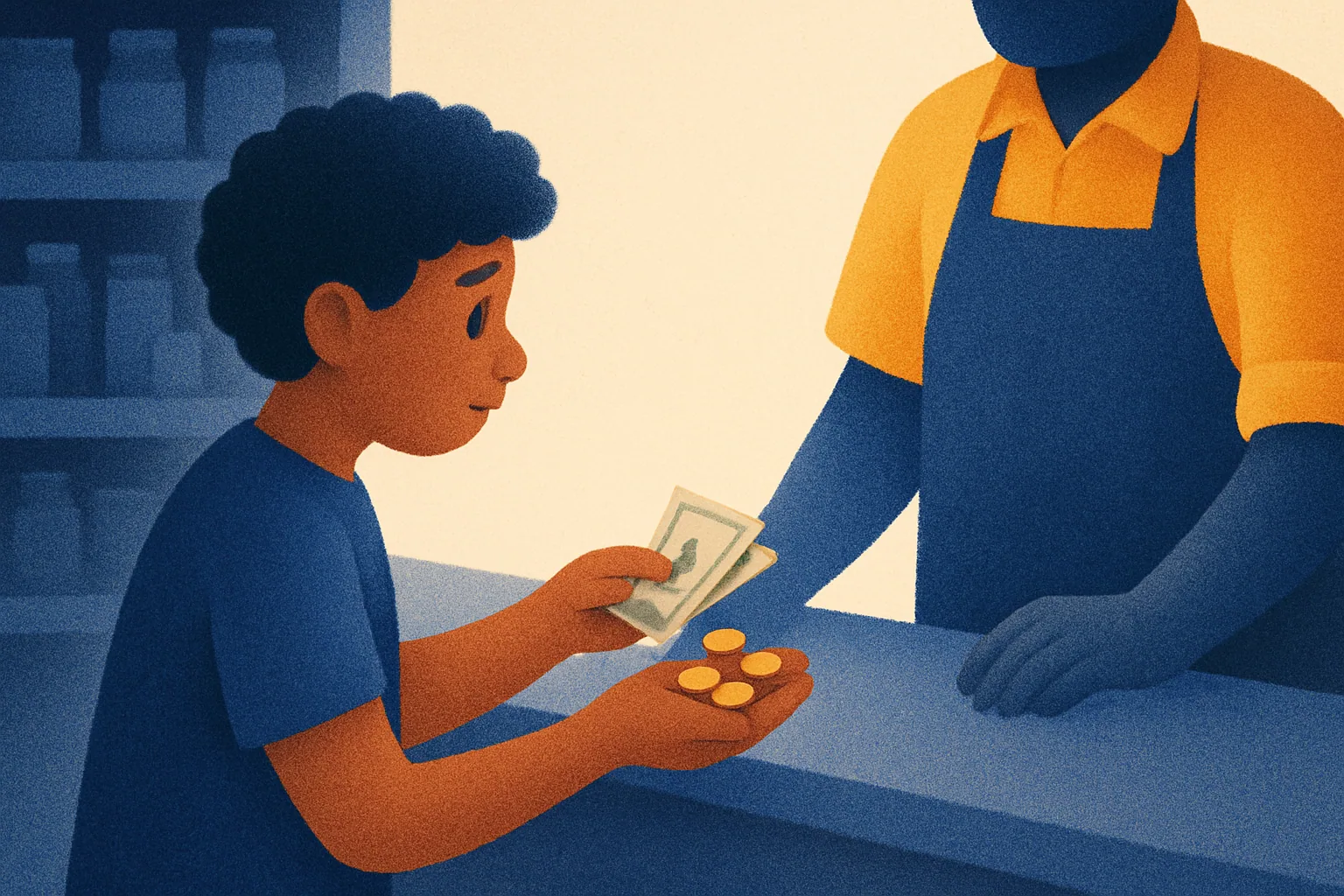
Most of the “how much allowance” debate has a quieter, more important question hiding underneath it: what is the kid actually supposed to pay for? A 10-year-old getting $10 a week is rich if his parents still buy every snack, every comic book, every birthday gift for every friend. He is poor if he’s expected to cover all of that out of the same $10. The number on the envelope means almost nothing without the rules around what the envelope has to cover.
This is the part that families almost always wing, and it’s the part that determines whether an allowance actually teaches anything. When parents quietly absorb every spending category the kid runs into, the allowance becomes pocket money for fun — never a budget. When parents over-shift and expect a 7-year-old to buy his own school supplies, the kid concludes that money is a source of anxiety, not a tool. The line between “parent’s job to buy” and “kid’s job to buy” should move as the kid gets older, and it should move in a calibrated, predictable way.
Here is what that line should look like, age by age, with the underlying principle that keeps it from being arbitrary.
The principle: parents pay for needs; kids increasingly pay for wants
The through-line for every age below is this: parents pay for needs and shared family items; kids pay for wants and personal preferences, and that share grows with age. Needs are food, shelter, basic clothing, education, healthcare, and the transportation that makes those happen. Those are parent-funded forever — or at least until the kid leaves the house. Wants are the designer-brand version of a thing the kid already has a perfectly fine version of, the video game, the snack on the way home from school, the concession-stand soda at a basketball game, the brand-new outfit that’s barely different from the three other outfits in the closet. Those start in the parent column when the kid is 5 and end almost entirely in the kid column by 17.
Ron Lieber, in The Opposite of Spoiled (HarperCollins, 2015), makes this distinction the foundation of how he thinks about kid spending: an allowance only does its job if there are things the kid actually has to use it for. Beth Kobliner, in Make Your Kid a Money Genius (Even If You’re Not) (Simon & Schuster, 2017), pushes the same point — the moment a kid realizes their money is the only source for some category of spending, the entire frame around that category changes. The kid stops asking. The kid starts calculating.
The point of moving the line gradually is that by the time the kid is 18, they have already spent ten or more years making trade-offs in real categories with real money. They’ve already had the experience of choosing the cheaper movie ticket because the concert is next weekend. The first time they make that trade-off shouldn’t be in college.
Age 5–7: kid pays for almost nothing
At this age, the kid pays for the impulse buys — and almost nothing else. The $3 toy at the grocery-store checkout. The $1 sticker pack at the bookstore. The small candy at the gas station. The little thing they spot at the cash register and ask for.
Most parents reflexively buy these. That reflex is the first thing to break. When a 6-year-old asks for the $3 toy at checkout, the answer isn’t “no” and it isn’t “yes” — it’s “you can buy it with your money.” Sometimes the kid will say yes. Sometimes they’ll get to the register, hold the toy, do the silent math, and put it back. Both outcomes are the lesson. The point is that there is now a decision attached to the toy, and the decision is the kid’s.
Keep the stakes very small. A 6-year-old should not be paying for school supplies, clothes, food at restaurants, or birthday gifts for friends. Those are all parent expenses. The kid’s allowance is a sandbox for learning what trade-offs feel like, and the trade-offs at this age should be measured in dollars, not double-digits.
Age 8–10: kid pays for “wants” at the store
The category broadens. By 8 or 9, the kid is paying for any small “want” they bring home: the small toy, the comic book, the trading cards, the in-app purchase on a tablet game, the upgraded pencil case that costs $15 when the perfectly functional one costs $4. The parent still buys the perfectly functional one. The delta is on the kid.
Concrete examples of where the line falls in this age range:
- Parent buys: all clothing, all food (groceries and restaurants), school supplies at the baseline level, books for school, the standard birthday gift for a friend if there’s a party that week.
- Kid buys: small toys, comic books, trading cards, the “I want this one specifically” version of a thing the parent would have bought a cheaper version of, in-app purchases on the kid’s own devices, candy and snacks beyond what’s already in the pantry.
This is the age where the in-app-purchase question shows up hard. A 9-year-old who plays a free mobile game and wants $5 of in-game currency is in the exact right zone — that’s a “want,” it’s small, and it’s a useful early lesson in how digital spending feels (which is, importantly, that it doesn’t feel like anything, which is precisely the problem). Make the kid pay it out of their own money. The moment they have to convert their own dollars into the in-game coins, the rate at which they want to buy more coins drops to a fraction of what it was.
Age 11–13: kid starts paying for “social”
Around 11 or 12, social spending starts to dominate. The kid is going to movies with friends. They’re hitting concession stands at basketball games. They want to grab a snack after school. They’re starting to have a phone with an app store on it.
This is the age where the lesson levels up from “do I want this toy” to “do I have enough to do this thing tonight.” That’s a major life-skill — running the in-real-time arithmetic on whether the planned outing fits in the budget, while standing in front of the snack counter, while everyone else is in line. That’s the calculation adults make every day. Kids who first encounter it at 19 are at an enormous disadvantage compared to kids who first encountered it at 12.
The parent still covers the school-clothing baseline. The kid pays the delta if they want the cooler version. If the parent buys a perfectly good $30 backpack and the kid wants the $85 one, the kid pays the $55 difference. Same for shoes, jackets, headphones, anything where there’s an obvious “fine” tier and an obvious “what the kid actually wants” tier.
Other category shifts in this band:
- Movies with friends: kid pays. (If the family is going together, parent pays.)
- Concession stand: kid pays.
- Birthday gifts for friends: transitioning — by 13, this is the kid’s.
- In-app purchases on the kid’s phone: kid pays, full stop. No exceptions.
- Snacks and drinks outside the house: kid pays.
The parent is still covering everything that resembles a need. Food at home, school clothes, transportation, healthcare, the phone bill, the family streaming subscriptions. The kid is paying for everything that resembles social discretion.
Age 14–16: meaningful personal budget
By 14 the kid is running something close to a real personal budget. They are paying for essentially all of their personal social spending — dates, concerts, gifts for friends, going out for food with friends, anything cosmetic that goes beyond practical. They’re probably starting to earn money from part-time work, babysitting, lawn care, or a structured family arrangement.
The single most useful move at this age is to switch the clothing line to a budget. Instead of the parent buying clothes ad hoc and the kid paying any delta, give the kid a clothing budget — monthly or seasonal — and let them manage it inside that envelope. The right number depends entirely on the family’s income; somewhere in the $50–$100 per month range is common, but families with higher or lower budgets calibrate accordingly. The number isn’t the point. The mechanism is.
Inside that envelope, the kid picks what they want. If they blow the whole monthly budget on one pair of jeans and have nothing left for socks for three weeks, that’s the lesson. The parent does not bail them out. The next month they get the same envelope and try again.
What the parent still pays for at this age:
- Phone bill (usually on the family plan)
- School fees, books, mandatory supplies
- Healthcare and insurance
- All shared family expenses — groceries, utilities, transportation when the kid is going somewhere on family business
- The clothing budget itself, deposited on schedule
What the kid pays for:
- Anything social or discretionary
- Their own data overages or premium app subscriptions if they want them
- Gifts for friends
- The clothing decisions inside the envelope
Age 17–18: pre-launch
By the senior year of high school, the kid should be running their own income — a part-time job, a side hustle, something — and paying for everything that isn’t food, shelter, healthcare, education, and family-shared expenses. The point of this year is that nothing about leaving home next year should be a surprise.
The parent provides: a roof, food in the house, healthcare, transportation that supports school and work, and tuition and books for college if that’s the family agreement. (Whether the parent funds college is a different conversation; some families do, some don’t, and either choice can be defensible. The point is to have decided.) Everything else is on the kid.
The single biggest failure mode at this age is the kid arriving at 19 having never paid for their own gas, their own phone, their own subscriptions, their own social life, their own gifts, their own anything — and being blindsided by how fast money actually disappears. The fix is to have made them feel that drag for three or four years before they leave. The kid who has been running a $400/month personal budget all through high school is dramatically more equipped to handle a real income than the kid whose parents handled everything until move-in day.
”But my kid won’t have anything” — the worry, and the reality
The single most common pushback when parents start shifting categories onto the kid is the worry that the kid won’t have what they need. The kid will feel deprived. The kid will be embarrassed in front of friends. The kid will be the only one at the movie without a snack.
The reality runs the other direction. Kids whose parents pay for everything tend to have more stuff than the kids who pay for some of it, and they tend to have less ability to figure out whether they actually wanted any of it. The friction of “I have to pay for that” is the lesson. The kid who decides not to buy the in-app currency because they’re saving for the concert is doing something the kid with infinite parental funding never has to do.
If the kid genuinely can’t afford things at the level the family thinks reasonable, the right move is to raise the allowance, not to absorb the cost back into the parent column. Quietly bailing them out negates the entire structure.
💡 In the TaskTroll app: Categorize Spend bucket expenses; the kid sees over time where their money went without you needing to comment on it. See tasktroll.com/features/allowance.
Read next
- Teaching kids about money: the complete guide — the pillar piece this clusters into.
- Allowance vs commission vs salary: which model actually teaches money — once you know what the kid is paying for, this is how you decide where the money comes from.
- How to teach a 10-year-old to budget — the budgeting mechanics for the age band where the social-spending shift starts.