Search “how to teach kids about money” and you will find roughly 9,000 articles with five tips each, and maybe three tips will be useful. The rest is platitude. “Model good habits.” “Start early.” “Make it fun.” None of it is wrong; none of it is actually a plan. It is the financial-literacy equivalent of “eat healthy and exercise” — technically correct, operationally useless. A parent who wants their 9-year-old to understand opportunity cost, their 14-year-old to run a real budget, or their 17-year-old to not be blindsided by their first paycheck needs more than tips. They need a calibrated age-by-age progression with honest tradeoffs and clear failure modes.
That is what this guide is. The structural assumption: money education is not a curriculum you sit a kid down and deliver. It’s a series of small, real, slightly-uncomfortable experiences that compound. The 6-year-old who blows their first allowance on candy and runs out before the week is up has learned more than the 12-year-old whose parents lectured them about saving but never let them feel the loss.
If your kid is way ahead of these ranges or way behind, that is normal — reference points, not targets. The pillar pairs with our chore-chart-by-age guide, which handles the work side. The two meet in the middle on the chores-and-allowance question — connected or separate — covered in allowance vs commission vs salary.
A note on the research
The “teaching kids about money” genre is unusually crowded with weakly-sourced claims — “kids who got an allowance had 23% higher net worth at 30,” “children who learn budgeting at 8 are more likely to be financially independent” — that trace back to small-cohort retrospective surveys with no controls. Marketing copy, not science.
Here is what is solid:
The Cambridge Children’s Money Habits study (Whitebread & Bingham, 2013), commissioned by the UK’s Money Advice Service and published out of the University of Cambridge, reviewed the developmental literature on when financial habits form and concluded that the basic patterns are largely in place by roughly age 7. The methodology is a literature synthesis plus observational work, not a randomized intervention — so it is “by roughly age 7,” not “exactly at age 7.” The practical implication: early-elementary is not too early, and not optional if you want the habits there in middle school.
Suniya Luthar’s research program on affluent adolescents, conducted across more than two decades at Columbia and Arizona State, is the rare body of peer-reviewed epidemiology in this space. Luthar puts depression and substance-use rates in adolescents from high-achieving affluent households at roughly 1.5–2.5× normative levels. The drivers are achievement pressure and emotional/physical isolation from parents — not lack of chores or financial responsibility per se. Madeline Levine’s clinical book The Price of Privilege (HarperCollins, 2006) layers a practitioner’s inference on top: being insulated from contribution and from financial reality is part of what makes the isolation feel hollow. Levine is interpretation; Luthar is the evidence.
Deci, Koestner, and Ryan’s 1999 meta-analysis in Psychological Bulletin synthesized 128 studies on extrinsic rewards and intrinsic motivation. The headline finding — the overjustification effect — is that tangible expected rewards reliably erode the intrinsic motivation they are trying to leverage, and the effect is roughly twice as strong in children as in adults. Directly relevant to whether you pay kids for chores, grades, or reading. Short version: be careful. Longer version: pitfalls section.
Warneken and Tomasello (2008) in Developmental Psychology extended this into very young children: when researchers paid 20-month-old toddlers for helping a struggling adult, the toddlers subsequently helped less in unrewarded situations than toddlers who had never been paid. The drive to participate is intrinsic and fragile. Money does not strengthen it.
What is not solid, and gets cited constantly: “Kids who got an allowance out-earned their peers by X%,” “Financially literate teens have Z% less credit card debt as adults.” Most are sponsored surveys by banks, fintechs, or financial-literacy nonprofits — small samples, no controls, retrospective self-report. Suggestive, not basis-for-parenting. The honest synthesis: early age-appropriate exposure to real financial decisions is supported. Specific dollar-figure outcome claims are not.
The structural question first: chores and allowance — connected or separate?
Every family has to answer one structural question first: is allowance tied to chores, or are they separate systems? The answer determines what allowance actually teaches.
There are two well-developed positions and one that does not work.
The Lieber/Kobliner position: keep them separate. Ron Lieber, in The Opposite of Spoiled (HarperCollins, 2015), argues that allowance is a teaching tool for money management — practice with saving, spending, and giving — and that tying it to chores conflates two different lessons. Chores are citizenship: you live here, you contribute. Allowance is a financial-literacy curriculum. Lieber’s starter heuristic is $0.50–$1 per year of age, per week — adjusted for cost of living, not a formula. Beth Kobliner takes the same stance in Make Your Kid a Money Genius (Simon & Schuster, 2017), framing it as “kids who got allowance without strings reached financial milestones earlier than kids who only got money for tasks.” (Treat as directional — the underlying surveys are weak.)
The Ramsey position: commission, not allowance. Dave Ramsey runs the opposite playbook. You do not give kids money for breathing — you pay them for work and call it commission. The argument is that this mirrors the adult economy and avoids the “money appears” expectation he sees as the seed of entitlement. Family chores (unpaid) and commissioned chores (paid) are bright-line separated.
The hybrid that does not work is the one most families accidentally fall into: pay for some chores, sometimes, when you remember, while also occasionally handing over cash. This produces the negotiating-toddler outcome — a 7-year-old who asks “how much” before emptying the trash. Pick one camp and stick with it.
For the full mechanics see allowance vs commission vs salary. This pillar uses the Lieber/Kobliner framing below — the overjustification research nudges in that direction — but the same age progression works under Ramsey’s commission model with minor adjustments.
Age 3–5: the “money is a thing that exists” years
At 3–5, the goal is recognition, not management. A preschooler does not understand abstract value, future planning, or deferring a $5 spend to next week. What they can understand: the round disk you call a quarter buys one specific gumball, paper bills go from your wallet to the cashier, and there is a jar in their room with their name on it.
Concrete is everything. A piggy bank — actual physical, transparent if possible — is more useful than any app. Coins going into a slot and rattling when shaken are doing real cognitive work. Digital balances are not, yet.
This is not the age for an allowance. Most families do best skipping it until 6, partly because younger kids do not have a meaningful spend universe, partly because the Warneken & Tomasello finding — money for participation can reduce participation — applies here too. Let the toddler help with the household because they want to (they do; see the chore chart by age guide), and let money be a separate, lightly-touched concept tied to the grocery store and the piggy bank.
What works at this age:
- Coins from your pocket into the piggy bank, slowly, narrating
- Handing the cashier a bill and taking the change back
- Using the words (“this costs four dollars,” “we have to wait until next paycheck”) in normal life without making it a lesson
- Counting the coin jar periodically, even if “counting” is lining up coins by color
Skip: app-based “starter” allowance products, formal save/spend/give systems, lessons about interest or compounding. None of that lands at 4.
Age 6–8: the start of an allowance
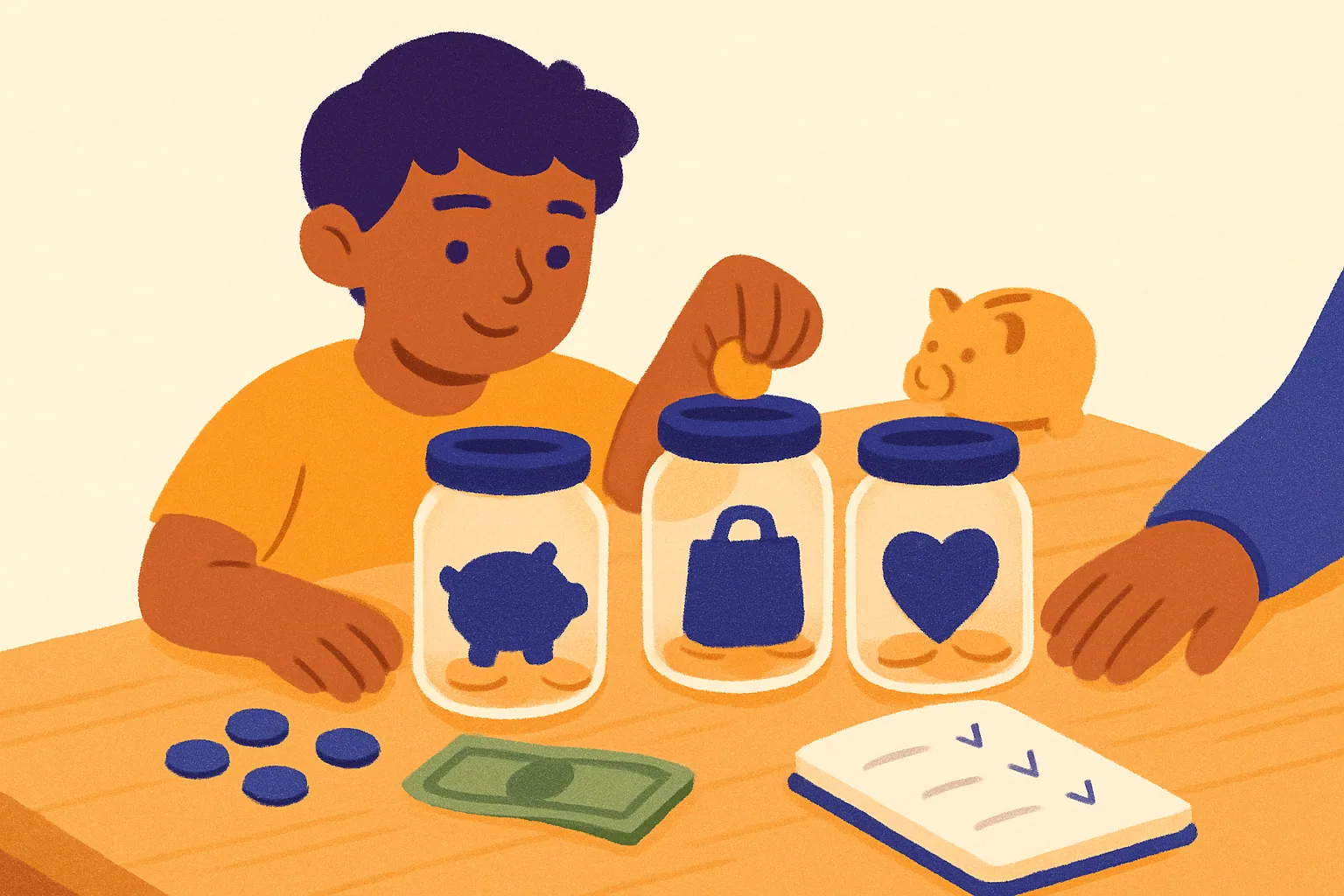
This is the window. Lieber, Kobliner, and the Cambridge habits-by-7 research all converge on early elementary as the right time to start an allowance with structure. The structure that consistently survives the first six months is the three-jar system: Save, Spend, Give.
Three physical jars on a shelf. Allowance arrives once a week — Lieber’s starter heuristic is $0.50–$1 per year of age per week, a starting point, not a rule. The number matters less than the consistency: same day every week, same amount, no negotiation. Kids are excellent at detecting which rules are real. An allowance that arrives “when I remember” teaches that money systems are unreliable — the opposite of the lesson.
The split is a household decision — roughly half Spend, a third Save, the rest Give is a common starting point — but the structure matters more than the ratios. We cover why jars still work when everything is cashless at save spend give jars in a cashless world.
The hard part of this stage is not designing the jars. It is sitting on your hands when the kid spends their entire Spend jar on candy in 20 minutes and then wants more on Wednesday. That is the lesson. When the Spend jar is empty, the answer is “wait until allowance day.” Not “just this once.” Not “if you do extra chores you can earn more.” The kid who learns at 7 that money runs out and you have to wait has internalized the most important financial concept there is, before they can spell budget. The parent who rescues this — top-up, workaround, buying the candy themselves — has erased the lesson.
The Save jar funds a medium-term goal (a toy, a game) that takes four to eight weeks. The Give jar funds a charitable donation a few times a year — kid picks the cause, parent goes along to deliver it in person. The “give” piece is not optional in Lieber’s framing, and the developmental research on generosity weakly supports it: doing the thing builds the identity.
Save / Spend / Give at this age is paper-and-jars, not apps. The physical accumulation is the curriculum.
Age 9–11: budgeting + savings goals
By 9, kids can hold a savings goal in their head for weeks, do arithmetic on a balance, and feel the trade between buying one thing now and a better thing later. This is the age to make the Save jar do real work.
Pick a real goal with the kid — a LEGO set, a video game, an outing — that lands in the 4–8 week range at their current allowance. That is a real wait, and the wait is the point. Opportunity cost is suddenly visible: every spend-jar candy purchase is one fewer week toward the LEGO jar. We go deeper at how to teach a 10-year-old to budget.
A simple spend log helps at this age — a notebook or notes-app page. The point is not record-keeping; it is the friction of writing it down, which forces a half-second of awareness before the next purchase. Many kids spontaneously cut impulse spends once they have to log them.
This is also where the parent-matching-funds question comes up. Should you match savings 1:1? Case for: it teaches that saving compounds and mirrors 401(k) matching. Case against: it can flip a kid from intrinsic (“I am saving for this thing I want”) to extrinsic (“I am saving because Mom doubles it”) — the overjustification effect again. Most families that match keep it modest (50%, or a flat bonus per completed goal). We unpack the math at parent matching funds for kids’ savings.
This is also the right age for the first slightly-uncomfortable financial conversation. Where does money come from in our family? What does “we can’t afford that right now” actually mean? Not a balance-sheet disclosure, but enough context that money is not magic.
Age 12–14: digital money + a real budget
Around 12, two things change at once. The spending universe goes cashless — Venmo between friends, in-app purchases, online ordering, gift cards. Physical jars stop being the primary container. And executive function is now adequate for a multi-line budget, even if judgment is still catching up.
This is the right age to introduce a debit card. Greenlight, GoHenry, Step, BusyKid, and Acorns Early are the major players in 2026, and they all do roughly the same things: parent-funded debit card, app-based controls, spending categories, chore-or-allowance integration, basic investing in some cases. We compare them at best first debit card for kids. (TaskTroll is building its own card-issuing feature with the same Save/Spend/Give structure baked in. We are not affiliated with any of the third-party products.)
The card is not the lesson. It is the container for the lesson. The lesson is a real budget the kid manages:
- A clothing budget. Research what your family actually spends per kid on clothes, divide by 12, hand it over monthly. They buy their own clothes. They overspend in October and have nothing for December. The shoes they pick are not the shoes you would have picked. That is fine.
- A school-supplies budget. Flat back-to-school amount, kid manages the list and the shop.
- A snacks-and-social budget. “Here’s what I’m giving you for basketball game snacks and movie outings this month. When it’s gone, it’s gone.” The friend who needs cash at the concession stand teaches more than any lecture.
Same rule as age 6: do not rescue. The 13-year-old who runs out of clothing budget and wears the same five shirts in November is having a real, useful financial experience. Many parents find this excruciating. The ones who cave have just unlearned the lesson and reset the clock.
This is also the age to name subscriptions out loud. Walk the kid through what your household pays per month for streaming, music, cloud storage, the various apps. Not a lecture — an audit. The 13-year-old who sees that Netflix + Spotify + Disney+ + Hulu + a games subscription adds up to $80/month is learning subscription literacy before they have any of their own. They will need this skill more than their parents did.
Age 15–17: pre-adult banking
By 15, the question changes from “is the kid learning about money” to “will this kid be ready to live independently in 2–4 years.” That is the real deadline. Most US banks allow joint checking accounts at 13 or 14 and solo accounts at 16 or 18. By 16, most kids should have a real checking account with their name on it and be moving the bulk of their financial life through it.
If they get a job — and many do at 15–16 — that paycheck goes into their checking account, not yours. They fill out their own W-4, see their own withholding, and have the brief irritating experience of looking at the bottom of their first pay stub and realizing what Uncle Sam took. That moment is one of the most cost-effective tax-literacy lessons available, and you cannot replicate it by explaining withholding at the dinner table. Let them feel it.
The other shift is logistics. A 16-year-old with a part-time job is negotiating three things at once: schedule, transport (gas costs real money), and the implicit hourly rate of their time. The kid working 12 hours a week, paying for their own gas, trying to hold a 3.5 GPA is doing real adult economics — deciding whether the extra shift is worth the SAT prep they will skip. Your job is to ask good questions, not to make the decision for them.
By 17, the realistic target list:
- Own checking account, knows the rough balance without looking
- Debit card, understands why credit cards are different (and dangerous)
- Has filled out at least one W-4 and looked at at least one pay stub
- Pays at least one recurring expense (gas, phone, streaming) from their own funds
- Can audit their subscriptions, has cancelled at least one
- Understands the shape of taxes — federal + state withholding, April return, refund is your money coming back, not free money
- Has at least one savings goal months out (a car, a trip, first month of college expenses)
- Has heard “credit score” enough to know it matters
The goal at 18 is not a rich kid. The goal is a kid who will not be blindsided by their first paycheck, will not panic the first time their checking account dips below zero, and will not sign up for the worst credit card pitched at them on a college campus. That bar is low and most American 18-year-olds fail to clear it. Clearing it is the win.
Common pitfalls
Most family money-systems do not fail because the system was bad. They fail because of a small number of recurring parent behaviors.
Parent-rescue. The most common failure mode by a wide margin, and it collapses every lesson above. The 7-year-old who spends their Spend jar Monday and is sad Tuesday does not need to be rescued. The 13-year-old who overspends their clothing budget does not need a top-up. The 16-year-old whose paycheck disappeared into snacks and Uber does not need a loan from Mom. Letting the consequence land is the whole curriculum. Rescuing is comfortable in the moment and devastating over time.
Inconsistent payment cadence. “I’ll pay you Saturday — I forgot, I’ll pay you Sunday — I forgot, here, I’ll just give you a twenty.” Kids stop trusting the system within about four cycles, and once trust is gone, so is the lesson. Pick a cadence and hit it.
Mixing chore-pay and allowance sloppily. Pick Lieber/Kobliner or pick Ramsey, but pick one. The negotiating-toddler outcome (“how much will you pay me?”) is the marker that the lines have blurred. See allowance vs commission vs salary for the recovery playbook.
Bribing for grades. Deci, Koestner & Ryan applies directly. Tangible expected rewards for academic performance reliably erode intrinsic motivation, and the effect is roughly twice as strong in children as in adults. The 4th-grader paid $5 per A becomes less interested in the material over time and more interested in negotiating the rate. Recognize a good semester another way — an outing, a family ritual, anything but cash per grade.
“Teaching” by lecture instead of by exposure. Money lessons do not land as “let me tell you about compound interest.” They land as “you spent your money, it’s gone, that’s how money works.” Lecturing feels productive to the parent and bounces off the kid.
The “let me handle the money” trap. Same shape as the “if I want it done right I do it myself” trap from the chore-chart pillar. The 10-year-old who buys their own birthday gift for a friend will pick a worse one than you would have and learn from it. The 10-year-old whose mom handles every transaction through age 17 has a college-aged kid who has never independently transacted. The cost of letting them do it badly is much lower than the cost of doing it for them, but it is more visible in the moment, and a lot of parents flinch.
How to actually implement
There are three reasonable ways to run a family money system. Most families do well with the simplest one they will actually maintain:
- Paper ledger + physical jars (ages 4–11). Three jars on a shelf, a spending notebook from age 9, allowance in cash on a consistent day. Cheap, tangible, hard to abuse.
- Shared notes app or spreadsheet (ages 11–14). Jars become categories in a Google Sheet or notes-app page. Allowance arrives via Venmo or debit-card top-up. The kid is digital-native but doesn’t yet need bank-grade infrastructure.
- A purpose-built family-money app (ages 6–16, especially with multiple kids or chore-allowance integration). Greenlight, GoHenry, Step, BusyKid, Acorns Early, and TaskTroll’s forthcoming card-issuing feature each handle recurring allowance, save/spend/give bucketing, and parental controls in one place. Reach for one if you have multiple kids and the math is hard to track by hand, you want chore-and-allowance integration without becoming the family accountant, or you want a debit card with parental visibility for a 12–16-year-old.
Honest take, same as the chore-chart pillar: most families do not need an app to start. A paper system and a consistent parent outperform a beautiful app and an inconsistent one every time. Start where you can sustain.
💡 In the TaskTroll app: Save / Spend / Give buckets — auto-split allowance the moment it’s earned, so the structure is invisible to the kid and bulletproof for you. See tasktroll.com/features/allowance.
Birthday and holiday money often arrives in chunks large enough to disrupt the system. Apply the same Save/Spend/Give split to gift money and the windfall doesn’t vanish in a weekend. We cover the mechanics — and the awkward conversation with grandparents — at birthday and holiday money for kids.
Sources & further reading
For anyone who wants to dig into the underlying research rather than take our word for it:
- Lieber, Ron (2015). The Opposite of Spoiled: Raising Kids Who Are Grounded, Generous, and Smart About Money. HarperCollins.
- Kobliner, Beth (2017). Make Your Kid a Money Genius (Even If You’re Not): A Parents’ Guide for Kids 3 to 23. Simon & Schuster.
- Levine, Madeline (2006). The Price of Privilege: How Parental Pressure and Material Advantage Are Creating a Generation of Disconnected and Unhappy Kids. HarperCollins.
- Luthar, S. S. & Latendresse, S. J. (2005). “Children of the Affluent: Challenges to Well-Being.” Current Directions in Psychological Science, 14(1), 49–53.
- Deci, E. L., Koestner, R., & Ryan, R. M. (1999). “A Meta-Analytic Review of Experiments Examining the Effects of Extrinsic Rewards on Intrinsic Motivation.” Psychological Bulletin, 125(6), 627–668.
- Warneken, F. & Tomasello, M. (2008). “Extrinsic Rewards Undermine Altruistic Tendencies in 20-Month-Olds.” Developmental Psychology, 44(6), 1785–1788.
- Whitebread, D. & Bingham, S. (2013). Habit Formation and Learning in Young Children. University of Cambridge / Money Advice Service. (The “by roughly age 7” study.)
- Ramsey, Dave. Smart Money Smart Kids (with Rachel Cruze, 2014) for the commission-not-allowance position in book form.
Closing
A real family money system is not a curriculum, and the jars and ledgers and cards and apps are not the answer. A calm parent who has decided what matters, who lets consequences land instead of rescuing, and who keeps doing it for ten years — that is the answer. The system just helps you remember the decision you already made.