The Best Way to Teach Kids to Save (Without Lecturing)
Lectures don't build savers. Structure does. Five household systems that actually teach kids to save money — and why none of them are 'sit down for a.
You sit your eight-year-old down at the kitchen table. You explain compound interest using a banana and a calculator. You talk about how if she saves $5 a week, by the time she’s a grown-up she’ll have — and at some point in there she’s stopped tracking what you’re saying and started thinking about the dog. She nods at the right places. She says “okay.” She agrees that saving is important. And then the next time allowance hits, she spends every dollar of it on a glitter pen and a packet of sour candy at the corner store, exactly like she would have if the talk had never happened.
The mistake is treating “saving” as a concept your kid needs to understand. It isn’t a concept. It’s a habit, and habits don’t get installed through conversation. They get installed through structure — the same way you didn’t teach your kid to brush their teeth with a lecture about cavities, you taught it by handing them a toothbrush every single night at the same time until brushing stopped being a choice. Saving works the same way. You build it through a handful of low-stakes, repeated decisions, set up so the right decision is the easy one. The talk is fine. The talk is not what changes anything.
What “saving” actually means at different ages
Saving isn’t a single skill. The mechanics look different depending on who’s doing it.
At 5, saving is putting a coin in a jar and not opening the jar for a while. That’s the entire skill. There’s no concept of interest, no goal, no time horizon longer than a few weeks. What’s being practiced is the bodily experience of having money and not spending it — the small, repeated act of choosing the jar over the candy at the checkout. That feeling is the whole thing. If the kid can do that ten times in a year, you’ve planted something real.
At 10, saving is a goal with a deadline. She wants a specific Lego set or a specific video game. She has $7 in her save jar and the thing costs $40. You don’t front her the rest; she works out how many weeks of allowance it’ll take, and then she waits. Four to eight weeks is the right window — long enough that it requires actual delay, short enough that the goal doesn’t dissolve. At this age the saving is still mostly emotional (“I want the thing more than I want what’s in front of me right now”), but it’s becoming arithmetic too.
At 14, saving is a checking-account balance that grows because the kid hasn’t spent it. There’s no physical jar anymore. The money is invisible — it’s a number on a phone screen — and the temptation is invisible too, because the spending happens with a tap. The skill at this stage is restraint without the visual cue. Same underlying skill as the five-year-old at the jar, played at a much higher difficulty level.
Different mechanics, same root: the willingness to delay. That’s what you’re building. Not literacy about money. Not knowledge of compound interest. The capacity to want something and wait.
The five systems that actually work
None of these are conversations. All of them are structures you set up once and then let do the work.
A visible save jar with a goal label
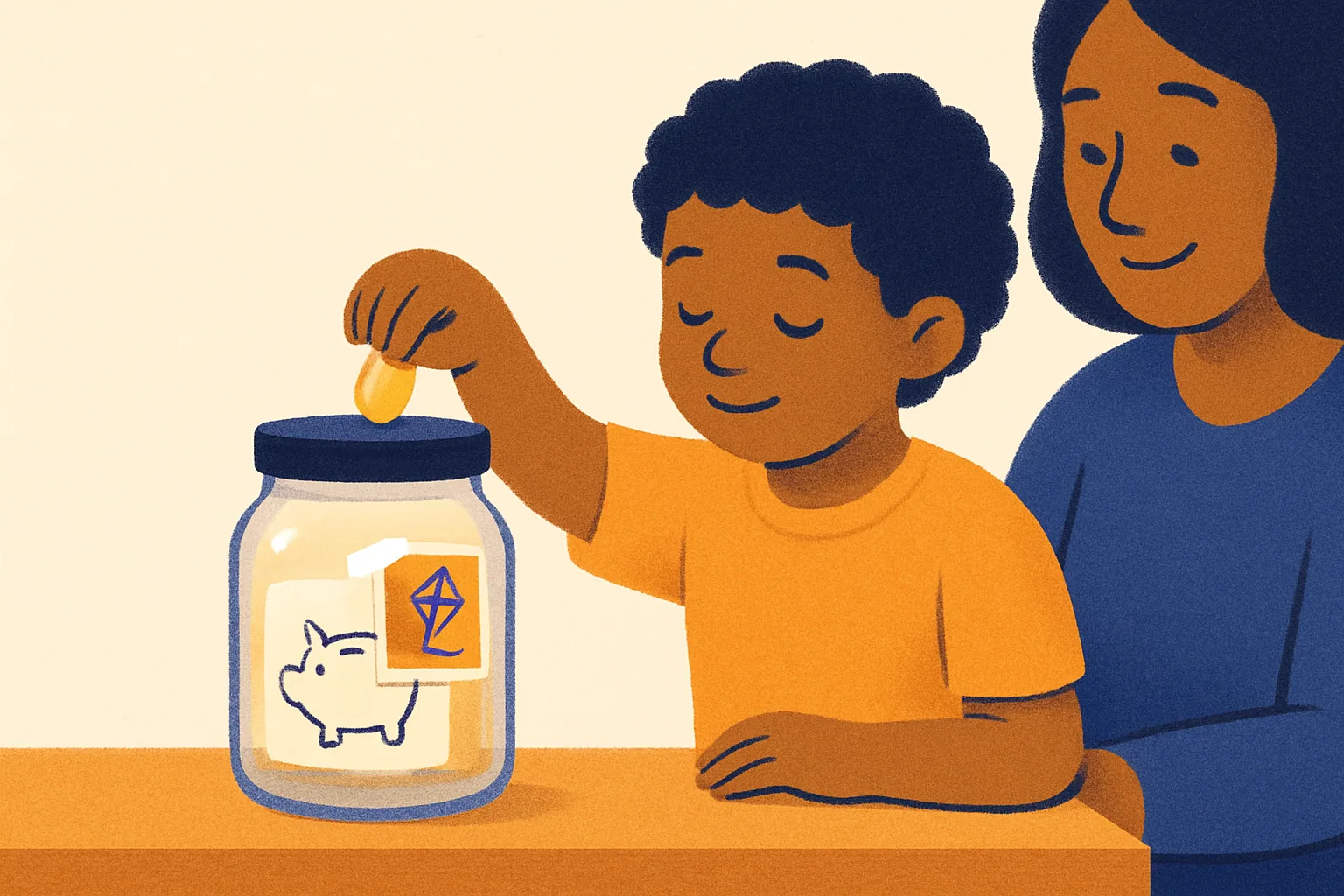
Physical jars work, and they work best from about age 4 through age 10 or 11. After that the money mostly stops being physical anyway. Get a clear container — a mason jar, a clear plastic candy jar, whatever you have. Stick a label on the front that says what the money is for. Drop the kid’s save-portion in it whenever allowance hits.
The visibility is the entire point. Money you can see is harder to forget about and easier to feel proud of. The kid walks past the jar every day, sees the level rising, and gets a tiny reinforcement loop that costs you nothing. A bank account at that age has the opposite property — the money disappears the moment it goes in. For a five-year-old, “disappeared into the bank” is functionally the same as “gone.” The jar fixes that.
Two practical notes. First, don’t put the jar in their bedroom where only they see it. Put it somewhere the family walks past — a kitchen shelf, the entryway — so the saving is visible to other adults and so the kid gets a tiny social reinforcement when grandparents notice. Second, when the goal is hit, let them buy the thing. The whole loop has to close, or the next time around they won’t trust that the jar leads anywhere.
Automatic split at the moment allowance hits
This is the single biggest structural lever and it’s the one most families skip. When allowance hits — whether you pay in cash or in an app — the money should be split into Save / Spend / Give buckets before the kid sees a single dollar. Not after. Not “and remember to put some in savings.” Before.
Ron Lieber, in The Opposite of Spoiled, frames this as the three-jar system, and it works because the kid is never holding “all their money.” They’re holding their spend money. The save money was never theirs to spend; it was always already saved. The split is invisible, the result is bulletproof, and you’ve eliminated the willpower battle that the lecture version was trying to win.
A reasonable starting split is something like 50% Spend / 40% Save / 10% Give, but the exact ratio matters less than the fact that it happens automatically every time. If you’re paying in cash, do the split before you hand the kid anything — three jars on the counter, you put the coins in the jars, the kid takes the Spend jar. If you’re using an app or a card, set the split as a rule the system enforces. Either way, the kid never has the decision in front of them. Eliminating decisions you don’t want a seven-year-old making is most of the parenting job.
A short-horizon savings goal (4–8 weeks)
Pick a thing. A specific toy, a video game, an experience — admission to the trampoline park, whatever. Has to be something the kid actually wants, not something you think they should want. Write the target dollar amount on the save jar label. Then wait.
Four to eight weeks is the sweet spot. Adults underestimate how long “long” is to a nine-year-old; six weeks is genuinely a long time at that age, plenty long to require real delay. But it’s not so long that the goal evaporates. Three months is too long. The kid loses the thread, the toy stops being the toy they wanted, and the saving feels pointless. One week is too short — it’s not really saving, it’s just delayed spending. The 4–8 week window is what teaches the actual skill.
You will be tempted, near the end, to chip in the last few dollars to speed things up. Don’t. The whole point is the waiting. If you front the last $4 because the kid is so close and you can tell she’s getting frustrated, you’ve just trained her that adults will close the gap when the math is hard. Let her finish it herself, even if it takes another two weeks.
Refusing to rescue
This is the most important rule, and the one parents break the most. Your kid spends their spend-jar on something dumb on Tuesday. On Saturday they want to do the thing — go to the movies with a friend, buy the snack at the pool, pick up the cool keychain — and they have nothing. They turn to you. They ask. Sometimes they cry.
You do not bail them out.
This is the entire lesson. The kid has to feel, in their body, what it is to have spent the money already and not have it now. That feeling is the whole thing the save-jar exercise is pointing at. If you rescue them — even once, even just this time — you have neutralized every other system in this article. The save jar isn’t teaching delay if there’s no real cost to not delaying. The spend-jar isn’t teaching choices if any bad choice gets erased.
This is hard. It’s hard because the kid is genuinely upset, and the upset is genuinely your fault for letting it happen, and the easy move is to put $5 on the counter and make the bad feeling go away. Don’t. The bad feeling is the curriculum. It will pass by Sunday afternoon. The lesson it leaves will not.
Matching, used carefully
A 1:1 match — for every dollar the kid puts in the save jar, you add another — accelerates savings dramatically. It makes the goal land faster. It also signals, in a way kids really do feel, that you take their saving seriously. Used for a specific big goal, it’s powerful.
Used as a permanent feature, it’s a problem. Two reasons. First, you’ve quietly doubled your kid’s allowance, which is your money, and that’s a bigger ongoing transfer than most parents intend. Second, and more importantly, you’ve added an external reward to a behavior — saving — that you specifically wanted them to do for internal reasons. Deci, Koestner, and Ryan’s 1999 meta-analysis in Psychological Bulletin synthesized 128 studies and found that tangible expected rewards reliably erode intrinsic motivation, with the effect roughly twice as strong in kids as in adults. The same dynamic that makes paid chores backfire applies here. A kid who saves to earn a parent match has been taught, by you, that saving is something you do for a reward. The minute the match stops, the saving stops.
Use it sparingly. A specific big goal — the bike, the trip, the college fund — is a good place for it. “Every dollar you save gets matched, forever” is not.
The “model it” myth
Every parenting article in the world ends with some version of “the most important thing is to model good saving habits yourself.” It’s not wrong. It’s almost useless as advice.
Here’s the problem: kids don’t see most adult financial behavior. Your 401(k) contribution comes out of your paycheck before it ever lands in your bank account — they can’t see it. Your mortgage payment is an automated transfer they have no visual access to. Your IRA contribution, your emergency-fund deposit, your debt payoff — all invisible. The financial behavior they do see is what you buy. You at the store, swiping the card. You ordering takeout. You at Target with the cart.
So the “modeling” that actually reaches the kid isn’t the saving — it’s the not-buying. And the way they pick up on it is when you say it out loud. “I’d rather wait and get the better one next month” — said in front of the kid, at the store, about a real purchase you really are skipping. That’s modeling restraint in a form they can actually witness. “Look at how much we put in our retirement account this year” doesn’t reach them. “We’re not getting the new TV this fall, the old one’s fine, I’d rather put that money somewhere else” — said while looking at TVs at Costco — actually does. Make the invisible reasoning visible by narrating it once or twice a month at the store. That’s the modeling that does anything.
What NOT to do
A few specific things that look like teaching and actively aren’t.
Don’t bribe them to save. “I’ll give you $10 if you save $50” trains them that saving comes with a reward attached. That’s exactly the inverse of the skill you wanted to build — saving was supposed to be the thing they did for the future payoff, not for an additional present payoff. Same overjustification mechanism as the match-everything-forever problem above, and worse, because it’s explicitly transactional.
Don’t lecture about compound interest at 8. The math is past them and the patience is past them. Compound-interest reasoning starts landing somewhere around 12 or 13, when they have both the arithmetic and the time-horizon for it to mean something. Before then, you’re not teaching, you’re performing. Save the conversation for when they have a checking account and an actual balance to do the math on.
Don’t threaten. “If you spend that dollar I’m cutting your allowance” turns money into a power struggle, and once it’s a power struggle, no one is learning to save — they’re learning to negotiate. Or hide. Let the natural consequences do the teaching (the refusal-to-rescue rule above). You don’t need to add artificial ones on top.
In the TaskTroll app: Auto-split Save / Spend / Give buckets — the structure happens before the kid sees the money. See tasktroll.com/features/allowance.
Read next
- The kids-and-money pillar — the full framework, age by age.
- Save / spend / give jars in a cashless world — how to keep the three-jar structure when nobody uses cash anymore.
- Parent matching funds for kids’ savings — when to use the 1:1 match, when to stop, and the overjustification trap.