Printable Chore Charts vs Apps: When Each One Actually Wins (2026)
Paper, app, or sticker chart? Honest tradeoffs by age and household, from the team that builds a chore app and will still tell you when paper wins.
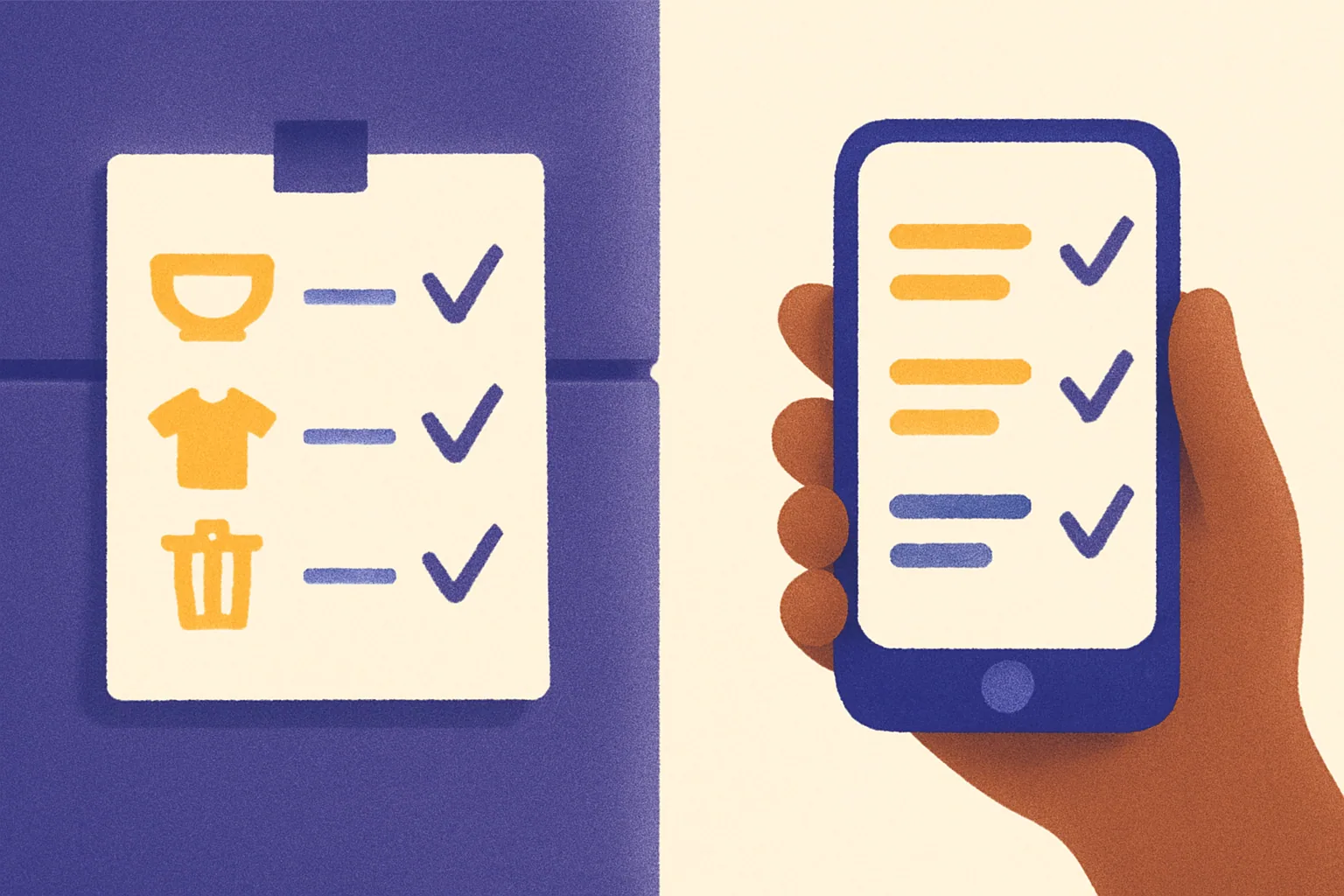
There are really only four ways households run a chore system, and after watching this play out across enough families to lose count, the pattern is always the same. The four options are: a sticker chart on the fridge, a paper checklist taped to the kitchen wall or stuck on the side of the cabinet, a shared digital list (the Notes app, Google Keep, Apple Reminders), or a dedicated chore app like the one our team builds.
We’re going to do something a little unusual for a content site published by a chore-app team: we’re going to tell you, honestly, when each of those wins. Including the embarrassing-for-us cases where paper beats the app every time.
Here’s the thesis up front. The chore system that works is not the one with the best features, the slickest UI, or the most science behind it. It’s the one you, the parent, will actually keep up with for more than three weeks. Every other variable is downstream of that single one. A handwritten sticky note that gets checked daily beats a beautifully designed app that gets ignored after the novelty wears off. We’ve seen it happen in both directions, dozens of times.
So the right question isn’t “what’s the best chore chart?” It’s “what’s the lowest-friction system I will maintain?” Let’s walk through the four options honestly.
Sticker charts (ages 4-7)
Sticker charts work. For about two to three weeks.
Then they decline, sharply, by month two or three. This is not because your particular kid is broken or because you bought the wrong stickers. It’s the overjustification effect, documented in the Deci, Koestner, and Ryan 1999 meta-analysis of 128 studies on extrinsic rewards and intrinsic motivation. When you reward a behavior the child was already willing to do, the reward eventually replaces the intrinsic interest. Take the reward away and the behavior drops below baseline. Keep the reward and you have to keep escalating it.
The temptation, when sticker fatigue sets in around week three, is to fix it with bigger rewards. Two stickers per chore. Then a prize after ten stickers. Then a bigger prize after twenty. That road ends at bribery, and the child has now learned that chores are something they get paid in stickers to tolerate rather than something that is just part of being in a family.
The honest take on sticker charts: they’re a starter tactic, not a system. Use one for a four-to-six-week run with a 4-to-7-year-old to get the routine established, then transition off of stickers before the overjustification effect kicks in. After that, the chart matters more than the reward on it. Don’t go looking for a more elaborate sticker system; graduate to a plain checklist where the reward is checking the box.
Paper checklists (ages 6-12)
Paper checklists punch far above their weight, and they are the workhorse of effective households.
A laminated paper checklist on the fridge or taped inside a cabinet door has properties that are genuinely hard to beat. It’s visible — your kid walks past it every time they enter the kitchen, which is six times a day. It’s immediate — checking off a box gives a small satisfaction that doesn’t require Wi-Fi, a battery, or a parent unlocking a phone. It’s low-friction — you can make one in five minutes with a Sharpie and a page protector. And it lets a child self-check without you being physically present, which is the single most underrated property of any chore system.
A paper checklist also can’t break. There’s no software update that will silently change behavior, no account that will get locked out, no notification that will get muted into oblivion. It is the same on Tuesday as it was on Monday.
The limitations are real but narrow. Paper doesn’t rotate chores automatically across siblings — you have to redo the chart when assignments change. Paper doesn’t track allowance math. Paper doesn’t sync between two households if you’re co-parenting. And paper does require you to laminate or re-print it occasionally.
For a single kid, ages roughly 6 through 12, with one primary parent running the system, paper is almost always the right answer. Not “an acceptable answer.” The right answer. We say this as the team that builds an app.
Shared digital lists (ages 9+)
For households that have aged past stickers and have a kid old enough to have device time, a shared digital list is the dark-horse option that almost nobody recommends.
Apple’s Reminders, Google Keep, the Notes app — any of these can hold a shared list that both parent and child can see and check off. They are free, lightweight, work on every device the child is likely to have, and put the chore list in the same place the kid is already looking ten times a day.
The big advantage of a shared digital list over paper is that the kid can check off a chore from their own phone, from anywhere in the house, without a parent hovering over the chart to verify. That sounds small. It is not small. It removes the surveillance feel that turns chores into a power struggle.
The limitations are also real. Shared digital lists have no rotation logic — you still have to manually rewrite who does which chore each week. They have no allowance or points tracking; if you want to tie chores to money, you’re keeping a separate spreadsheet. And they have no age-based presets, so you’re inventing the chore list from scratch.
For a household with one or two kids, no money-tracking component, and a parent who is comfortable rewriting the list weekly, a shared digital list is plenty. It is much better than most people give it credit for.
Dedicated chore apps (ages 6-16, multi-kid)
A dedicated chore app — TaskTroll, or any of the others — is worth the additional friction in three specific situations. If none of these three apply to you, an app is probably overkill.
First, multiple kids with rotations. If you have three kids and Wednesday is “load the dishwasher” and the assignment rotates weekly, doing that on paper is genuinely annoying. You’re rewriting the chart every Sunday night. An app that just handles “rotate this chore across these three names” earns its keep.
Second, allowance or points tied to chores. If you want your kid to earn money or screen time or some other currency per chore, and you want any kind of running ledger, doing that on paper turns you into the family accountant. An app that tracks accruals and payouts removes a real maintenance burden from the parent.
Third, a kid who genuinely responds to gamification. Some kids do. Some kids don’t. You’ll know which yours is. If yours lights up at points, streaks, badges, and progress bars, an app captures that motivation. If yours rolls their eyes at gamified anything, an app is just one more thing for them to ignore.
If none of those three apply, paper or a shared digital list is probably the better fit. We will say that plainly.
When paper wins
Paper wins when:
- You have one kid, or one kid is the only one currently doing chores.
- One parent is the primary system-runner; you’re not coordinating across two households.
- You don’t need to tie chores to allowance or points math.
- Your kid is not the type who genuinely responds to gamification.
- You want something you can set up in five minutes and that costs nothing.
That is a description of an enormous fraction of households. Probably the majority. Paper is simpler, faster to start, free, and impossible to break with a software update or a billing problem. It does not require either parent or child to remember a password. It does not need permissions. It does not lose data.
Don’t overcomplicate. If paper fits, use paper.
When an app wins
An app wins when one or more of these is true:
- You have multiple kids and chores rotate. Rewriting the rotation every week is exactly the kind of repetitive parental admin work software is good at removing.
- You’re tying chores to allowance, savings buckets, or some other points currency, and you want the math handled.
- You’re co-parenting across two households. A paper chart at Mom’s house doesn’t sync to Dad’s house. The kid does the same chores at both, the same expectations follow them across the handoff, and the parent who isn’t there can still see what got done.
- You have a gamification-loving kid for whom streaks and badges and points are genuine motivators.
The honest version: most households don’t have all four of those. Many have one or two. If you have at least two, an app is probably worth trying. If you have none, save the friction.
The honest test
Here is the one test we’d run if we were starting over with a new family.
Pick the lowest-friction option you will actually maintain for eight weeks straight. Not the option you think you should use. Not the option that sounds best. The one you will, realistically, keep up with on a Tuesday night in week six when you’re tired.
We have watched families succeed with a handwritten chore list on a single sticky note. We have watched families fail with the most polished, well-reviewed app on the market. The chart is not the variable. Parent consistency is.
💡 In the TaskTroll app: Free 14-day trial — try it alongside whatever paper system you have now. If after two weeks the app isn’t earning its keep, go back to paper without losing anything. See tasktroll.com.