Kid-Run Lemonade Stand: The Permit, the Profit, the Lessons
Honest playbook for a kid lemonade stand that actually nets money — the cost math, the (very real) local permit issue, location strategy, and the lessons.
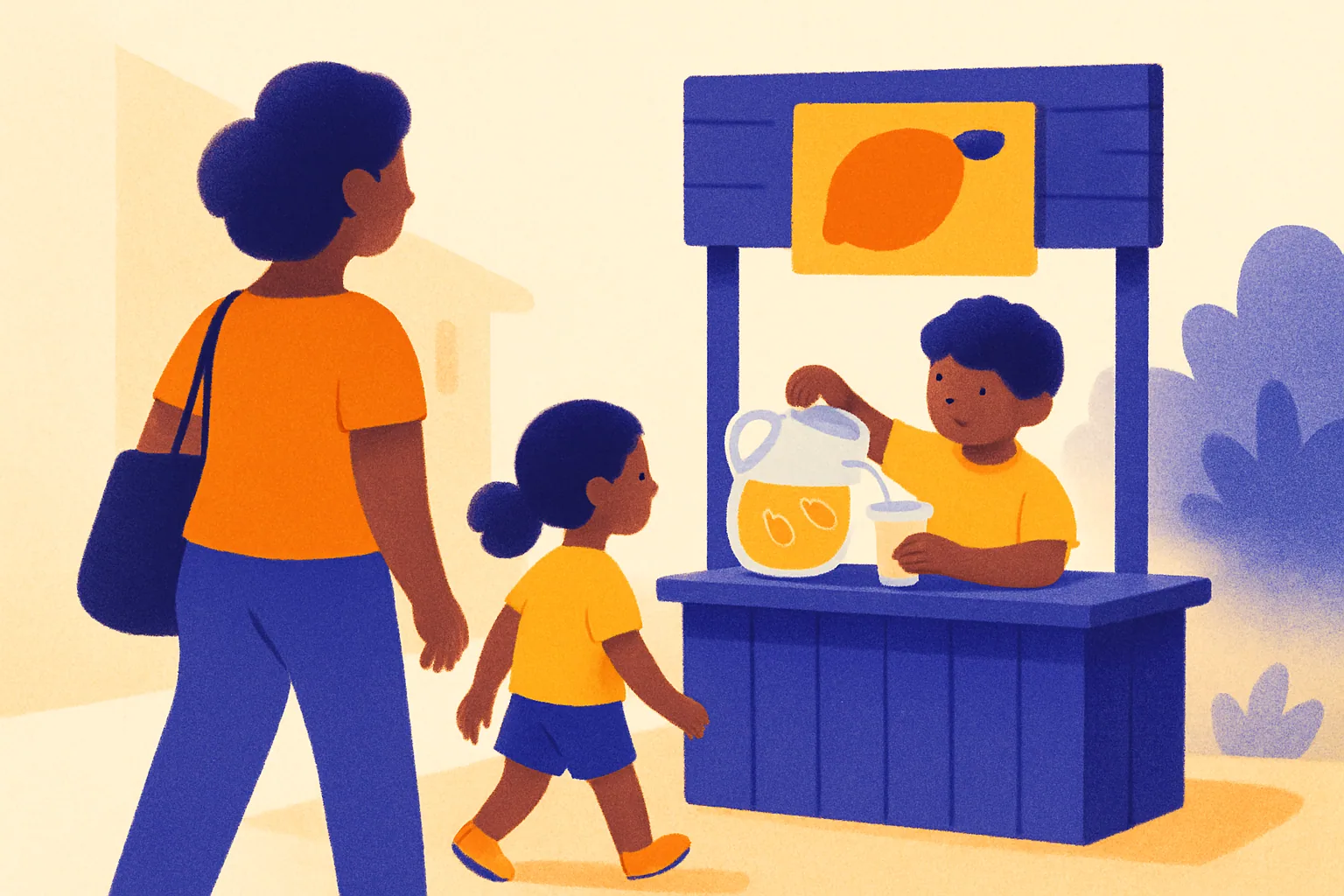
The lemonade stand is the archetypal first kid business. Almost every American childhood has a snapshot of it: a card table, a hand-drawn sign with a backwards letter, a pitcher sweating in the sun, and a kid making change with the focused intensity of a Wall Street trader. Most parents wing it. The kid sells eight cups to neighbors who were going to walk by anyway, pockets $8, and everyone calls it a success. Photos go up. The pitcher goes back in the cabinet.
This post is for the parent who wants something a little more than that. Not in a stage-parent way — the lemonade stand isn’t supposed to be a startup. But if the kid is going to spend a Saturday running one, it’s worth setting it up so they actually NET money, learn the structural lessons that apply to any future business, AND walk away with a clearer picture of how the world of work and money really fits together. A few small decisions — about cost, location, permits, product mix, and what to do with the cash — turn a $8 afternoon into a real first business experience.
The cost math
A realistic stand isn’t free. Here’s a typical setup, with grocery-store prices that haven’t changed much:
Inputs:
- Lemonade powder (one big canister): about $3.
- Sugar (if your powder is unsweetened, or for a fresh-squeezed version): about $1.
- 50-pack of cups: about $4.
- Pitcher: assume you already own one. If not, borrow.
- Signage: free if homemade — and the homemade sign is the better sign anyway.
Total materials: about $8 for roughly 50 cups of capacity.
Revenue scenarios:
- At $1/cup × 30 cups sold over a three-hour stand: $30 gross. Profit ~$22.
- At $2/cup × 25 cups sold (premium pricing, slower volume): $50 gross. Profit ~$42.
- At $0.50/cup × 60 cups sold (low-price, high-volume experiment): $30 gross. Profit ~$22.
Hourly:
$22 profit ÷ 3 hours = about $7.30/hour. That is below most W-2 hourly rates, but it’s a perfectly reasonable number for an 8–12 year old running their own operation, and the customer interactions are the real lesson anyway.
A couple of things to notice. The $2/cup scenario yields the most profit, but only if your location can support a premium price (event-adjacent, captive thirsty crowd). The $0.50/cup version produces the same profit as $1/cup but requires double the foot traffic. Pricing isn’t a vibe — it’s a function of who’s walking by, how thirsty they are, and what else they could spend $1 on right that moment.
It is also worth talking to the kid about what their time is “worth” in this context. $7/hr feels low next to a teenager’s babysitting rate, but the lemonade stand is a different kind of work: the kid is the entire business, not just the labor. They’re also learning skills (pricing, sales, customer service, basic accounting) that pay back for decades. Framing it as a paid internship rather than a wage job tends to land better.
For a broader pricing framework — including how to think about hourly versus per-unit, and when to raise prices — see how much should a kid charge.
The very real permit issue
This is the part most lemonade-stand articles skip, and it’s the part that has actually generated news headlines. In some US cities and most states, technically a lemonade stand requires a food-service permit, the same as any other vendor selling consumable product to the public. Several state health departments have, over the years, shown up and shut kids’ stands down. It makes the local news every time, but it does happen.
Two things are simultaneously true:
- It’s widely reported and inconsistent. Many jurisdictions look the other way for an obvious kid-run summer stand. Some do not.
- The story has gotten enough attention that Country Time Lemonade ran a “Legal-Ade” program that covered kids’ permit fees and fines after the news cycles. And state-level “lemonade stand laws” — explicit exemptions for kid-run, occasional, non-commercial stands — have passed in roughly twenty states, with the count slowly growing. The list changes; check yours.
Practical guidance (not legal advice):
- In most neighborhoods, on private property (your front yard, driveway, sidewalk in front of your own house in some places), a kid-run summer lemonade stand is fine in practice. The risk is low and the social acceptance is high.
- On public property — a city park, a public sidewalk downtown, a community plaza — the rules are stricter, the foot traffic is higher, and the chance of someone official asking questions goes up.
- If your municipality, HOA, or downtown district is famously strict — and you’ll know if it is — look it up before you set up. A 30-second search for “[your city] lemonade stand permit” usually surfaces the answer, or at least a recent local article.
- If a code enforcement officer ever stops by, the kid being polite, packing up gracefully, and saying “thank you, sorry” is itself a lesson worth more than the lost revenue.
To be very clear: this isn’t legal advice. Your city’s permitting rules are the source of truth. The point of mentioning this isn’t to scare you out of running a stand — it’s so you’re not surprised, and so the kid hears, age-appropriately, that even very small businesses operate inside rules made by other people. That’s a foundational concept.
Location strategy
Here is the single biggest lever in the whole exercise, and the one most stands get wrong. Most kids set up at the end of their own driveway, where roughly three cars drive by per hour and zero pedestrians do. Real lemonade-stand revenue depends on foot traffic, not car traffic. A car going 25 mph doesn’t stop for $1 lemonade. A person walking past on a hot day does.
Better locations, in rough order of how much they multiply revenue:
- Outside a community garage-sale day — built-in foot traffic, people already in shopping mode.
- At the local park during a youth-soccer Saturday — parents standing around, kids overheating, ideal demand curve.
- On the route to/from a school event — with parent permission and the event organizer’s blessing.
- At the family’s own yard sale, as a “side stand” — combines two efforts and shares signage.
- Coordinated with a local 5K race or community event — this is the huge multiplier. Hundreds of thirsty people, all walking past, all in a generous mood. A well-placed stand at the finish-line route of a neighborhood 5K can clear $100+ in one morning, occasionally more.
Negotiate location BEFORE the day. Ask. Most event organizers will say yes to a kid; many will actively help, pointing the stand to a higher-traffic corner or letting it piggyback on their signage. A great location with mediocre lemonade still beats great lemonade at a dead intersection, every single time. If you take only one piece of advice from this whole post, take this one: spend more energy on where the table goes than on the recipe.
The product side
Fresh-squeezed lemonade beats powder on taste and on repeat customers, but it costs more in time and ingredients. For a one-day stand, powder is fine. For a stand that runs the same spot two weekends in a row trying to build regulars, fresh is worth it.
Add-on items multiply revenue, and this is where stands punch above their weight:
- Cookies at $1 each. Margins on a homemade cookie are roughly three to four times the margin on a cup of lemonade. Half of all lemonade buyers will add one if it’s right there.
- Capri-Sun or juice boxes for kids who hate lemons. Buy in a multi-pack, sell individually. You make roughly $0.25/unit, which adds up.
- Cold water bottles on hot days. Some buyers genuinely just want water; don’t make them walk away.
Keep the SKU count low — three to four items maximum. A kid-run stand with seven items is logistical chaos and forgotten change. Three items is a real menu: a drink, an upsell snack, and a non-lemonade alternative. Anything more and the kid spends the day apologizing for being out of things instead of selling.
One more product note: presentation matters more than recipe. A clean table, a hand-lettered sign with clear prices, ice that actually looks cold, and cups stacked neatly will outsell a slightly better-tasting product on a messy table every time. This is true at the kid lemonade stand and it is true at every restaurant on Main Street.
The customer interaction lessons
This is the real value of the whole exercise, and it’s why “the kid only made $22” is the wrong scorecard:
- Saying thank you to every customer, even the rude ones.
- Counting change correctly under pressure, with a line forming.
- Handling a sold-out moment with grace: “I’m so sorry, we’re out — I’ll have more tomorrow at the same time!”
- The “regular customer” moment, when someone from yesterday comes back. The kid’s face when this happens is the whole point.
- Asking the customer what they thought after they bought it. “Was it sweet enough?” Real product feedback, in real time.
These aren’t lemonade lessons. They’re customer-service lessons, and they apply to every job the kid will ever have — from babysitting at fourteen, to a first retail job at sixteen, to whatever business they eventually run. The pitcher is just the pretext.
What to do with the money
Don’t let the cash disappear into a wallet or a junk drawer. The cleanest split is the three-bucket approach — Save, Spend, Give — covered in save-spend-give-jars-cashless-world.
Add a fourth envelope for this particular case: “Re-invest in next stand.” That’s the working-capital concept made physical. Before the kid splits the rest into Save/Spend/Give, they peel off enough to buy next weekend’s powder, cups, and signage. They see, in their hands, the difference between revenue, cost of goods, and take-home profit. That’s a concept most adults don’t fully internalize until they run a real P&L.
💡 In the TaskTroll app: Log lemonade-stand revenue into a separate income source (not allowance) so the kid sees their EARNED money grow distinctly from family transfers. See tasktroll.com/entrepreneur.
Read next
- Kid and Teen Side Hustles: The Full Guide — the pillar that this post supports, covering the full landscape of first businesses by age.
- How Much Should a Kid Charge? — the pricing framework that applies to lemonade, lawn-mowing, babysitting, and every business after.