Co-Parenting Through the Teen Years: When Kids Want a Direct Line
Teen kids increasingly want to talk directly to each parent and run their own schedule. Here's how to evolve from parent-mediated communication to.
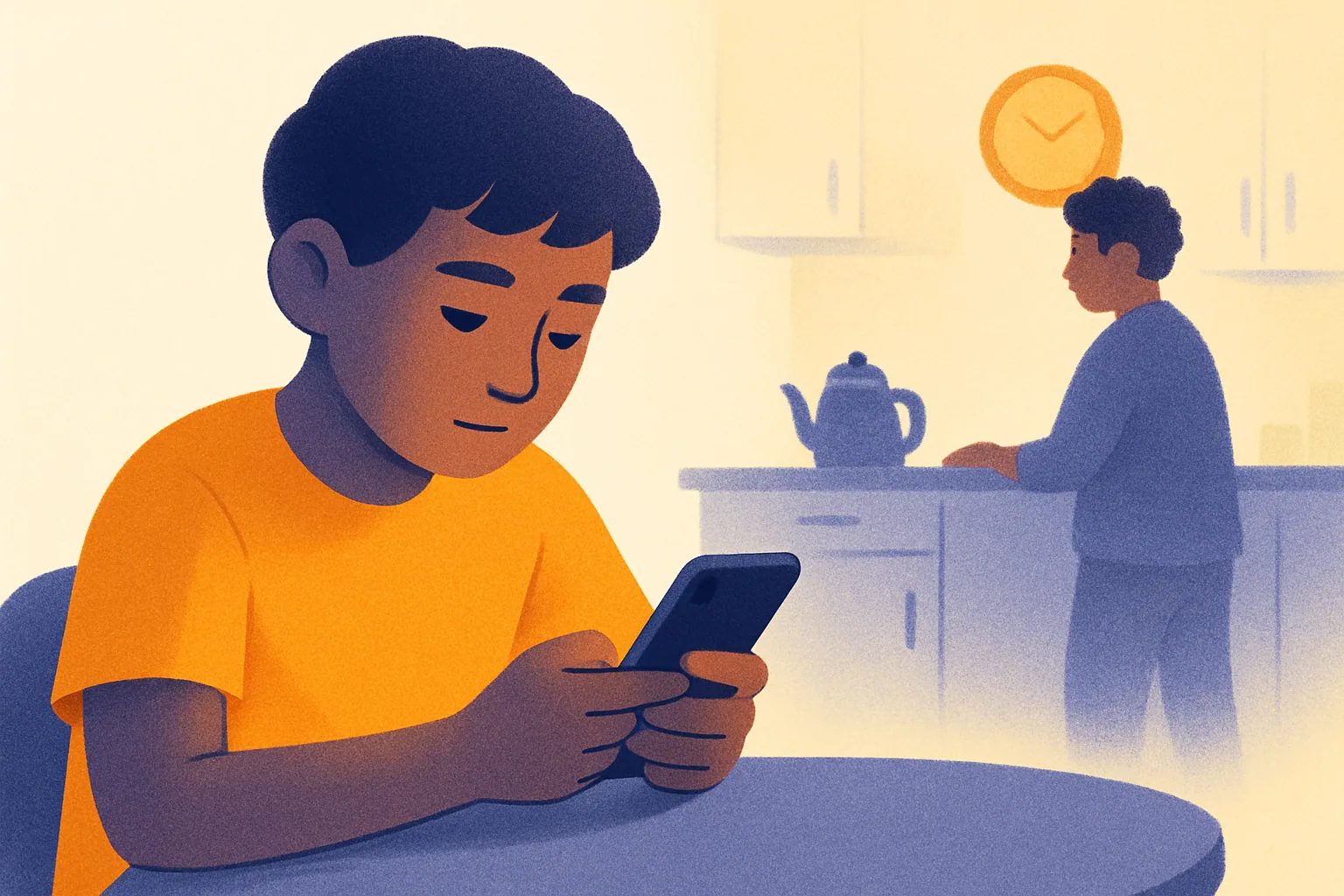
The co-parenting infrastructure you built when your kid was seven does not fit the kid at fourteen. When the kid was seven, every transition between households was an adult production: bags packed by a parent, ride coordinated by a parent, school pickup confirmed in a parent-to-parent text, “did she remember her inhaler” routed through the shared app. The seven-year-old was the cargo. The parents were the logistics. The system you built — shared calendar, color-coded weeks, every Tuesday-handoff documented — was correct for that kid.
The fourteen-year-old wants their own phone, their own schedule, and their own direct line to each of you. They want to text Mom about a sleepover without it going through Dad’s inbox first, and they want to ask Dad about borrowing the car without Mom’s name being copied on the message. They are not trying to undermine the co-parenting setup. They are trying to grow up, which is the whole job. The challenge is evolving the system to let them do that without abandoning the coordination that actually keeps them safe — the part where both parents still know what’s going on, still make the big decisions together, and still notice the same warning signs at the same time.
The shift from “managed” to “informed”
At seven, the parents fully manage the kid’s logistics. Where the kid is, what they ate, what time they got picked up from soccer, what the teacher said about the math test, whether they remembered to bring the science project home — all of it lives in the adult layer. The kid’s job is to show up at the things adults have arranged. The co-parent system is dense and active because the kid has no operational role yet.
At seventeen, the kid is largely running their own life. They drive themselves to work, they make their own dentist appointment when their tooth hurts, they tell each parent separately what their plans are for the weekend, they handle most of their own money. The parents are mostly back-channel — informed, available, weighing in on the big stuff, paying for the non-discretionary stuff, but not in the middle of every logistical thread. The co-parent system at seventeen is sparse: custody schedule that’s mostly a suggestion, a few shared expenses, occasional “FYI Dad, she’s home sick” messages.
The teen years — roughly twelve to seventeen — are the gradient between those two states. The co-parent system needs to slide along the same gradient. Fewer entries on the shared calendar, not more. Fewer parent-to-parent texts about what the kid is doing, because the kid is now telling you directly. More tolerance for “I’m at Mom’s this week, I’ll text you for stuff” and less anxiety about losing visibility. The instinct to lock things down tighter as the kid gets older is the wrong instinct. The instinct should be the opposite: lighten the apparatus as the kid takes over their own life.
Real shifts that happen between 12 and 17
Schedule flexibility increases
The strict 2-2-3 or alternating-week schedule that worked beautifully when the kid was nine becomes a fiction by fifteen. The fifteen-year-old has practice Tuesday, a job Wednesday, a project group Thursday at a friend’s house, and a Saturday tournament that bleeds into Sunday morning. The custody-order line about “every other Thursday” stops mapping onto reality. Most healthy co-parenting setups end up with something like “Tuesday and Thursday with Dad, kid floats other nights based on their own plans, weekends mostly with Mom unless something specific comes up.” The legal schedule can stay on paper exactly as ordered — courts generally do not care that practice is more flexible than the document — but the practice itself loosens. The important conversation is the one between the co-parents: both of you need to actually be okay with the looser version, or one of you needs to say so before it becomes a resentment. A teen who senses that one parent is silently keeping score of “missed nights” learns very quickly to game it.
Direct teen-to-parent communication
The teen has both parents’ numbers now and uses them. They text Dad directly to ask about borrowing the car. They text Mom directly to say they’re sleeping at a friend’s. The co-parents stop being the routing layer for routine kid logistics, which is good — that was always the kid’s job to grow into. The risk is that “direct communication” turns into “siloed communication,” where each parent has half the picture and neither knows the kid is, say, blowing off school on Wednesdays. Direct teen-to-parent threads are fine. Each parent staying informed enough not to be surprised by what their kid is up to is non-negotiable.
Activity logistics move to the teen
Driving to practice, managing a work schedule, calling to confirm the orthodontist appointment, picking up the prescription, signing up for the SAT — the teen takes over more of this every year. By sixteen, with a license, most of the daily logistics layer that the parents used to own can shift onto the kid. The co-parents move from logisticians to backup. The shared calendar gets thinner. The shared expense ledger may actually get more complex (more stuff costs money now) but the play-by-play traffic drops a lot.
Money flows more directly
A sixteen-year-old with a job and a debit card may pay for their own concert ticket and just need permission to go. The co-parents probably should not be litigating who owes whom $12.50 for the movie ticket the kid bought themselves. The expense ledger should narrow at this age, not widen — it should cover the things the parents are co-funding (insurance, phone bill, school costs, sport fees) and let the kid’s own money handle their own discretionary stuff. Putting a sixteen-year-old’s spending decisions through a parental cost-split fight is a great way to make them resent the system, the money, and both parents at once.
What still needs co-parent coordination
Even as the teen takes over their own life, certain things still belong to the parents and have to stay co-owned:
Big-ticket decisions. Driving lessons. International travel. Choice of college and how it gets paid for. Medical decisions of any consequence — orthodontia, mental health treatment, elective surgery, the decision to put a teen on or off a medication. These should not be made unilaterally by whichever parent the kid asked first. The teen will (correctly) push for fast answers; the co-parents need a habit of saying “let me talk to your other parent and get back to you tomorrow” without it being a fight.
Safety threshold issues. Suspected substance use, mental health warning signs, the teen lying about where they’re spending the night, dating someone the parents have real concerns about, signs the teen is being unsafe online or with someone older. Both parents need to be in sync on these — not necessarily agreeing on the response, but knowing the same facts at the same time. The teen needs to know the parents are in sync, too. Silos around safety stuff are the dangerous part of the teen years.
Money for non-discretionary stuff. Health insurance premiums, phone bill, basic clothing, school supplies, tuition or activity fees, car insurance if there’s a kid driver. These are co-parent ledger items. They do not move to the teen’s debit card. The teen does not “decide” about their health insurance.
The “no triangulation” rule
This is the single most important specific habit for the teen years. Teenagers, even the wonderful ones, become extremely skilled at playing one parent against the other. “Mom said it was fine.” “Dad already said no, but I figured I’d ask you.” “Mom doesn’t care about that anymore.” It is not malicious — it is rational behavior from a person who has just figured out that two adults with different rules creates an arbitrage opportunity. The fix is mechanical, not emotional: cross-check anything ambiguous before answering. A quick “have you talked to your mom about this?” or “give me a minute, I want to text your dad” — said out loud, in front of the kid, no apology — is what kills the strategy. You do not have to agree with your co-parent on the final answer. You absolutely have to not be played. After a few times of “your dad said you already asked him and the answer was no,” the teen stops trying. After a few times of “my parents talk to each other,” the teen actually feels safer, even if they complain about it.
What the shared app should look like by 16
By the time the kid is sixteen, the shared parenting app should be noticeably slimmer than it was at seven:
- Custody schedule — present, loosely enforced, mostly used to track which parent is on-call when.
- Big-ticket calendar items only — surgery, travel, college visits, parent-teacher conferences, the few real handoffs that still matter. Not “practice at 4.”
- Shared expense ledger for the things you’re co-funding — insurance, phone, school, car-related costs, medical co-pays.
- Communication channel still useful for routine “FYI” updates between parents — “she’s home sick today,” “heads-up he’s struggling in chemistry,” “his coach called me, want me to forward the message.”
That’s roughly it. If your shared app at sixteen is as dense as it was at seven, something is off — either the kid hasn’t been allowed to grow into their own logistics, or one of you is using the app as a surveillance tool, or both. Trim it back deliberately.
When the teen wants out of the system entirely
Somewhere around fifteen or sixteen, the teen may say something like “can you guys stop talking about me in your app, I’ll just text you both directly.” This is mostly a reasonable request. It is worth saying back to them: the app is not for you. The app is for the two of us to coordinate the things we’re still on the hook for — your insurance, your school costs, your big stuff. Most of what’s in it is parent-side logistics you do not need to see, and you are not going to start seeing it. What changes for them — what they actually care about — is that the day-to-day “what is the kid doing tonight” traffic mostly moves off the app and onto direct teen-to-parent threads. That part you can give them. The underlying coordination layer stays, quietly, where it belongs.
In the TaskTroll app: Teen Mode lets a kid age 13+ have their own login, see their own calendar, and contribute updates without parental approval on every edit, while co-parents still see the underlying data. Learn more at tasktroll.com/features/co-parenting.
The honest summary of co-parenting a teenager: the system you built does not need to get bigger. It needs to fade out in the right order, in the right places, while staying solid in the few places that still matter. The goal is a seventeen-year-old who runs their own life, who has a real relationship with each of you separately, and who knows — without ever being told — that the two of you still talk about the things that count.
Read next
- Co-Parenting Apps and Systems in 2026 — the pillar guide to coordination tools across the conflict spectrum.
- Chores and Responsibilities for Teens 14-17 — what the household contribution side looks like at this age.