Chores for 8-10 Year Olds: Bumping Up Responsibility (and Pay) in 2026
What 8-10 year olds can really do, what safety lines hold (no, not a push mower yet), and how to shift from chore chart to chore ownership.
An 8-to-10 year old can, functionally, run most of a household for short stretches. They can do their own laundry start to finish, cook a real (if basic) meal alongside an adult, clean a bathroom that meets a reasonable adult standard, take primary responsibility for a pet, and keep their room and homework on a weekly rhythm without you reminding them every twenty minutes. The capability is there. If you’ve been doing the work of building from age 4 onward — invitations at 4, scaffolded chores at 5, basic routines at 6, real expectations at 7 — this is the age where the compounding starts to actually show up.
What changes at 8-10 isn’t capability. It’s social orientation. Peers start to matter more than parents in a way they didn’t at 7. The chore chart that worked beautifully at 6 with its sticker grid starts getting eye rolls. “Why do I have to?” stops being curiosity and starts being a rhetorical question. That’s not a regression — it’s normal social development, and chore systems that don’t adapt to it tend to collapse at exactly this age. The fix isn’t to crack down. The fix is to shift the frame from “do these tasks” to “you own this domain.” More on that below.
What 8-10 year olds can actually do
This is the broadest competency range in the whole age-by-age guide. By 10 most kids can handle nearly any household task that doesn’t involve fire, sharp full-size blades, chemical cleaners, or a power mower. Here’s a realistic list:
- Independent laundry, start to finish — sort by color, run the washer, transfer to the dryer, fold, put away. The first ten cycles need a parent walking through it with them. After that, this is genuinely their job.
- Simple stovetop cooking with an adult in the kitchen — eggs, grilled cheese, pasta with a jar sauce, quesadillas, oatmeal, pancakes from a mix. Not “alone in the kitchen with the stove on.” With an adult in the same room within arm’s reach of the burner. AAP’s general guidance is that consistent unsupervised stove use is more a 12+ skill.
- Bathroom cleaning with kid-safe products — vinegar, dish soap, baking soda, water. Not bleach, not Lysol, not Drano, not any spray that has a warning label. Cleaning the toilet bowl, wiping the sink, wiping the mirror, swapping the towels. Bleach and other harsh disinfectants stay an adult tool until they’re old enough to read warning labels and follow ventilation instructions reliably — typically 12+.
- Full pet responsibility — feeding, fresh water twice a day, scooping litter or picking up the yard, brushing, walking the dog (with an adult or another responsible person, not solo around traffic at 8). This is the domain-ownership move and it works well at this age.
- Vacuum the whole house — not just one room. Empty the canister. Move light furniture. Realistic on a weekly cadence at this age.
- Change their own sheets weekly — strip, wash, remake. Tuck the fitted sheet. The first five times need a parent showing them; after that it’s a Saturday routine.
- Pack their own lunch — sandwich or wrap, fruit, snack, water bottle, ice pack. Most 8-year-olds can do this if you stop doing it for them.
- Make a simple breakfast for themselves — cereal, toast, fruit, yogurt parfait, no-cook breakfast burritos.
- Take out trash and recycling — including roll-the-bin-to-the-curb on collection day.
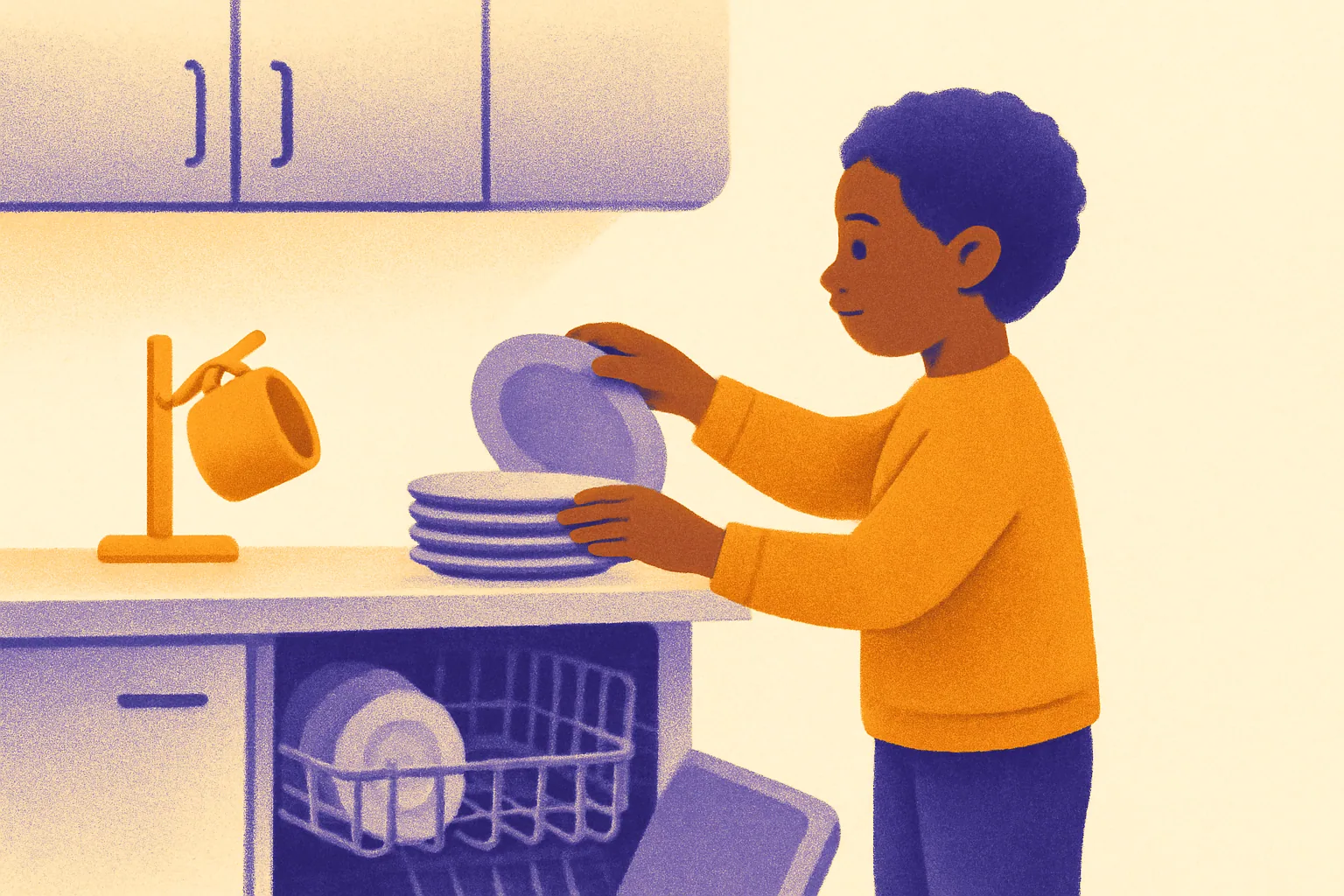
- Empty and load the dishwasher — including putting glassware away on high shelves with a step stool, and handling (non-knife) silverware.
- Sweep and mop floors — kitchen, entry, bathroom.
- Wipe down kitchen counters and stovetop (after it’s cool — adults handle the hot cleanup).
- Make their bed properly — including pulling the fitted sheet smooth, not just throwing a comforter on top.
- Manage their own homework start time — a 10-year-old can be told “homework starts at 4” and self-launch. They may need a single check-in at 4:05; they shouldn’t need to be sat down with.
- Help with grocery shopping — read a list, find items, comparison-check unit prices (this is one of the best early money-skills exercises there is).
- Walk to a friend’s house in the neighborhood — within whatever radius your family has agreed on, with a phone or a check-in plan. (This is judgement, not a chore, but it’s part of the autonomy curve.)
- Manage their own morning routine — including being out the door on time for school, dressed and fed, with their bag packed.
If you’re looking at this list and thinking “my 9-year-old does maybe three of these” — that’s normal. Most American 9-year-olds are operating well below their developmental ceiling on household work. That’s not a kid problem; it’s a system problem. We talk about how to close that gap below.
Safety floors that don’t move at this age
This is the most important section in the post. Some things sound reasonable for a competent 10-year-old that just aren’t, because the injury data is unambiguous. Be honest with yourself about these.
Push mowers and lawn mowers — the floor is 12. Both the U.S. Consumer Product Safety Commission and the American Academy of Pediatrics set the minimum age for operating a walk-behind power mower at 12, and for riding mowers at 16. This is not a “soft” guideline. CPSC injury data has consistently shown that lawn mower injuries are a leading cause of major limb amputations in American children — kids losing fingers, toes, feet, and lower legs. The mechanism is usually not “kid mowed over their own foot” — it’s slipping on a slope, the discharge chute, or a younger child wandering into the path. A 10-year-old who is mature, careful, and asking to mow is not the safe edge case. The age floor is the age floor. Wait. They’ll mow plenty of lawns from 12 to 18.
Babysitting — AAP’s minimum is 12. At 8-10, “watching” a younger sibling means being in the same room with them while an adult is in the same house, one room away. It is not actual responsibility for the younger child’s safety. We see well-meaning parents start to use a competent 9-year-old as a true babysitter — “I’ll just run to the store for 20 minutes” — and that crosses a meaningful line. A 9-year-old’s prefrontal cortex isn’t equipped to make the kind of emergency call (fire, choking, injury, intruder) that real babysitting can demand. AAP, the American Red Cross babysitter training program, and most state child-welfare guidelines line up at 12 as the minimum age for actual babysitting responsibility.
Hot iron unsupervised — supervise the first dozen uses. A 9-year-old can absolutely iron a school uniform shirt. They will also leave the iron face-down on the board the first few times because they got distracted. Supervise until you’ve seen them do it cleanly a dozen times in a row.
Chemical cleaners — bleach and harsh disinfectants stay an adult tool. This is partly about the chemicals themselves (bleach + ammonia produces toxic chloramine gas; most kids don’t yet know which household products contain which) and partly about the warning labels: at 8-10 they can read the labels, but they can’t yet reliably act on the warnings every single time. Save bleach, drain cleaners, oven cleaners, and concentrated disinfectants for adult chores. Vinegar, dish soap, baking soda, and water clean almost everything in a house just fine.
Knives that aren’t kid knives. A small paring knife with adult supervision is fine. The chef’s knife is not yet.
These aren’t a list to be guilty about — they’re a list to be matter-of-fact about. “We don’t do the mower until 12 in our family, that’s the rule.” Kids accept clear, consistent rules a lot better than ad-hoc ones.
Yard work that IS appropriate
Plenty of yard work at this age is fine and useful:
- Rake leaves and bag them
- Pull weeds (teach them what weeds look like first — losing a few perennials is normal in the learning curve)
- Bag and dispose of grass clippings after an adult mows
- Sweep walkways, the driveway, the back patio
- Water plants and the lawn
- Plant simple flowers or vegetables
- Pick up sticks before mowing day (this is actually mower safety — kids contribute to the mowing process by clearing the lawn first)
- Snow shoveling, with breaks — a 10-year-old shoveling for 30 minutes straight in cold air is fine; an hour without breaks is too much for their cardiovascular tolerance
You can also let them watch an adult mow a few times and walk through how the engine starts when the mower is cold and turned off — pulling the cord, choke position, blade-engagement lever. It’s fine for them to understand how the machine works. Operating it under load is still 12+.
Shift from chart to domain ownership
This is the single biggest mental shift at 8-10. The sticker-chart era is ending. What replaces it is domain ownership.
At 6, “feed the dog at 7am, fill the water at 7am, brush the dog on Tuesdays” works because the kid likes the chart and the system gives them the structure they need. At 9, the same chart starts to feel like surveillance, and pushback follows. The fix is to compress that whole list into one sentence: “You are responsible for the dog.”
Domain ownership lands better at this age because it reads as trust, not as a list of demands. Saturday morning if the water bowl is empty, you don’t say “you didn’t fill the water bowl, that’s chore #3 on your list.” You say “hey — the dog.” That’s it. They know what they’re responsible for. They get to figure out their own rhythm for hitting it.
The other shift is from daily to weekly. Most 8-10 year olds do better with a weekly rhythm than a daily checklist. “Saturday is laundry day.” “Sunday after dinner is room-reset day.” “Wednesday is take-the-trash-out day.” Daily checklists at this age start to feel like being five again. Weekly rhythms feel like being twelve.
What you lose with this move: granular visibility into what’s getting done each day. What you gain: a kid who’s actually building the executive-function muscle of running their own domain. The first move is worth it. You’ll know within two weeks whether they’re actually owning the domain — the dog’s water will be empty, or it won’t.
The “if I want it done right I do it myself” trap
This is the most common failure mode at this age and we see it constantly. A 10-year-old packing their own lunch takes 12 minutes the first month. You packing it takes 4 minutes. The math is obvious; the long-term cost is invisible.
The compound difference over six years — from age 10 to age 16, when they’re getting their license — matters enormously. The kid who has been packing their own lunch since 10 walks into high school knowing how to feed themselves a balanced meal. The kid whose lunch got packed every day until 14 walks into high school assuming that food appears. Same kids, same intelligence, completely different functional adults.
Eat the 8 minutes. Read a book, drink your coffee slower, scroll your phone, whatever. Don’t take the lunch back over. The 8 minutes is the investment; the 16-year-old who knows how to function is the return.
The same logic applies to laundry, bathroom cleaning, and bed-making. Their version is going to be 60-80% as good as yours, for years. Accept it. The standard at this age is “done by them,” not “done to your spec.”
Money + chores at this age
8-10 is the age where the chore-and-allowance question gets real, because the kid has actual purchasing interests now (video games, books, things at the mall with friends) and the dollar amounts they understand have grown. Our allowance vs. commission vs. salary post goes deep on the three main systems and which families each one fits. The very short version:
- Core chores are unpaid, allowance is a separate money-skills teaching tool. This is the model Ron Lieber and most child psychologists recommend. Core chores happen because you’re part of the family; allowance happens so the kid has dollars to make real money decisions with. The two aren’t connected.
- Commission model (the Dave Ramsey approach): every chore has a dollar value attached and the kid earns the total. This has defenders too, especially among families where the kid is genuinely motivated by money.
Either system works at this age — what matters more than which one you pick is that you actually run it consistently for a year. The pillar has the full debate.
A reasonable allowance range at 8-10 in 2026 is roughly $5-$15/week depending on family budget and what the kid is expected to cover from it (snacks at school? entertainment? gifts for siblings?). That’s not a hard rule — it’s a starting point.
💡 In the TaskTroll app: Domain Ownership — assign a kid a category (Dog, Kitchen Cleanup, Yard) rather than 12 micro-tasks. See tasktroll.com/features/chores.
Read next
- The full age-by-age pillar: Chore Chart by Age: The 2026 Guide for Every Stage
- Going deeper on the money side: Allowance vs. Commission vs. Salary: Which Chore-Pay System Actually Works