Chores for 5-7 Year Olds: The Sweet Spot for Building Habits (2026 Guide)
Realistic chore lists for kids ages 5-7, plus the systems that actually make chores stick at the age when kids most want to be useful.
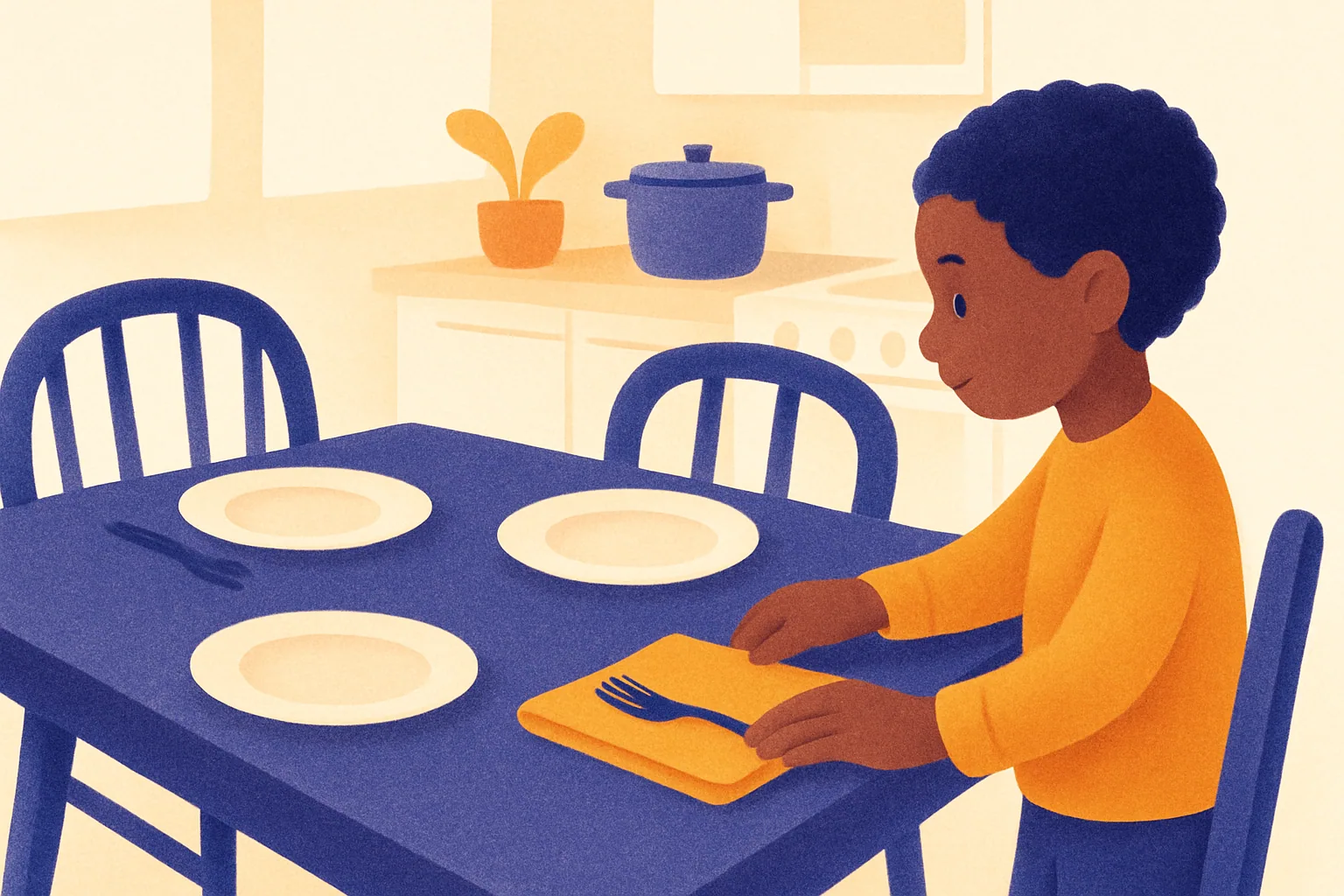
Five to seven is the window where chores most reliably land. Not because these kids are suddenly capable of running a household — they aren’t — but because they care, in a way they won’t quite care again, about being seen as competent. A 6-year-old who is allowed to set the table will set the table with the seriousness of a person being trusted with something real. That’s the version of your kid you’re working with for about three years, and it is a genuinely useful window.
It’s also the window where most family chore systems either get built or quietly get put off. The two outcomes look identical at age 6 — the kitchen is still mostly tidy either way, because you’re doing the tidying — but they diverge fast. The kid who has been quietly absorbing the household routine through this period becomes a 9-year-old who knows how a household runs. The kid who hasn’t becomes a 9-year-old you’re trying to teach for the first time, against a wall of “but I’ve never had to do that before.” You can absolutely catch up later. It’s just harder, and the relationship cost is higher. Better to use the window.
This post is the focused 5-7 cut of our age-by-age chore chart guide. If you want the full progression from toddler to teen, start there.
Why this age, specifically
The developmental framework most often cited here is Erik Erikson’s “industry vs. inferiority” stage, which he placed roughly at ages 6-11. Erikson’s observation was that elementary-age kids start measuring themselves by whether they can produce real things — and that being denied the chance to do real, useful work in this window leaves a residue of inferiority that’s hard to undo later.
The honest framing: Erikson’s stages are a clinician’s framework from the 1950s, not a tested hypothesis. They’ve never been validated the way a randomized trial would validate them. But they’ve remained useful enough that the framework is still taught in essentially every developmental psychology course and shows up in current pediatric textbooks. The application to chores is illustration, not science. Our pillar guide’s research note treats this in fuller detail, including what does and doesn’t actually replicate.
What we’d say more confidently: 5-7 year olds have functioning short-term memory, can read at least a simple list, can sequence multi-step tasks, and visibly light up when trusted with grown-up work. Whether you call that “industry” or just “the age where they want to be useful,” it’s the same practical observation. Use it.
A realistic 5-7 chore list
The 15 items below are organized by where in the house they happen. Pick 4-6 daily ones plus 1-2 weekly. A 6-year-old can’t track 15 things at once and you’d hate the chart that tried to make them.
Self-care
- Get dressed independently. Pick clothes the night before to skip the morning fight.
- Make their bed. “Covers pulled up, pillow on top” is the standard. Hospital corners are not the standard. The bed not being made perfectly is not a discipline issue.
- Brush their own teeth — but a parent still does the real follow-up brush at night. The American Academy of Pediatric Dentistry’s rule of thumb is that supervised brushing continues until the kid can tie shoes or write in cursive, which is typically age 7-8. AAP HealthyChildren stretches supervision to about age 10. Kid does the first pass; you do the actual cleaning pass.
- Put dirty clothes in the hamper without being asked.
Around the kitchen
- Set the table — napkins, silverware, plates, eventually glasses with water.
- Clear their own plate after meals. At 7, clearing everyone’s.
- Unload non-sharp items from the dishwasher — plates, plastics, cups. Knives stay an adult job.
- Make their own breakfast on weekends — cereal, yogurt, microwave oatmeal, toast. The first dozen times will be messy. That’s the cost.
Safety note: dishwasher pods are the single most common cleaning-product injury in elementary-age kids. They look like candy. Keep them in a locked cabinet, or switch to liquid or powder detergent until your youngest is past about age 8. This is not theoretical — pediatric poison-control reports flag pods specifically as the top detergent injury in this age band.
Tidying
- Tidy their own room to a real standard (toys away, books on the shelf, clothes off the floor).
- Bring in the mail.
- Empty small bathroom or bedroom trash bins into the kitchen bin.
Pets and plants
- Feed pets a pre-measured scoop you’ve set out — don’t ask a 5-year-old to read measurements yet.
- Refill the water bowl.
- Water indoor plants. They will overwater. Plants are fine.
- Walk the dog on a short supervised route (older end of this band, with you on the leash).
That’s it. There are bigger lists on the internet. They’re aspirational, not realistic. A 6-year-old who consistently does six of these is doing more than most adults’ 6-year-olds do.
What’s NOT yet realistic at this age
Most chore-chart articles online quietly assume too much. Things to keep off the 5-7 chart:
- The hot stovetop unsupervised. Microwave is fine. Stovetop with you in the kitchen, watching, is fine for an older 7. Alone is not.
- Push mowers, of any kind. The Consumer Product Safety Commission and AAP both set the floor for operating a walk-behind power mower at age 12. Riding mowers wait until 16. Mower injuries are the leading cause of major childhood amputations in the US. This isn’t conservative parenting — it’s load-bearing data.
- Chemical cleaners. Bleach, harsh disinfectants, oven cleaner, drain cleaner all stay adult tools through this age. Water and a designated cloth is enough to wipe a sink.
- Babysitting siblings. The AAP minimum age for actual babysitting is 12. A 6-year-old can keep a younger sibling company in the same room while you’re one room away. That’s companionship, not childcare.
How to actually run it at this age
A paper chart on the fridge works great here. So does a clipboard. So does a sticky note. The technology of the chart doesn’t really matter — what matters is that it’s visible, it’s the same every day, and the kid can read it without you reading it to them.
Aim for 4-6 daily chores plus 1-2 weekly chores. More than that and the chart becomes a source of nagging instead of a system. If you can only land three, land three.
Hook chores to predictable times, not “when I tell you.” Bed gets made before screen time. Dishes get cleared right after dinner. Teeth get brushed before story. The chore feels like part of the routine rather than a request that has to be negotiated each time. The reason this matters: at this age, “is this rule actually real or is it just something Mom says sometimes” is genuinely an open question, and kids are excellent at figuring out which is which.
Skipped chore = small natural consequence. No screens until the bed is made. No dessert until the plate is cleared. Quiet, predictable, low-emotion. The consequence is the rule — it isn’t an additional punishment layered on top of the rule. Big emotional consequences (yelling, lectures, lost weekend privileges over a missed napkin) reliably backfire at this age. The kid stops hearing the rule and starts bracing for the storm. The system stops working.
Don’t pile on praise. Acknowledgment (“you got the whole table set, nice work”) is fine. Big effusive praise for routine work tends to backfire later — by 8 the kid notices it’s performative, and they start performing the chore for the praise rather than because it’s their job. Quiet recognition is the durable version.
The allowance question (briefly)
This is the age where the allowance conversation usually starts, often because the kid asks. Two positions worth knowing, both summarized at greater length in the pillar’s pitfalls section:
- Ron Lieber (The Opposite of Spoiled) and Beth Kobliner (Make Your Kid a Money Genius) both argue that allowance and chores should stay completely separate. Allowance is a money-skills teaching tool — save, spend, give. Chores are a citizenship obligation. You don’t get paid to be in the family.
- Dave Ramsey runs the opposite playbook: commission, not allowance. Kids work, kids get paid. The lesson is “money is something you earn.”
Both work. What doesn’t work is the sloppy hybrid — paying for some chores but not others, with the line shifting depending on the week. That produces the 7-year-old who negotiates a rate before emptying the trash and the 14-year-old who can’t help a roommate without resentment. Pick one and hold it.
For more on the mechanics, see our companion post: how much allowance per chore (publishing same day).
When the system fails — almost always inconsistency
When parents tell us their 6-year-old’s chore system “didn’t work,” roughly 9 times out of 10 the diagnosis is the same: it was enforced four days a week instead of seven. A chore system enforced four days a week is a chore system that doesn’t exist — the kid has correctly figured out that the rule isn’t actually a rule, and they’re playing the odds.
The fix isn’t more discipline. It’s fewer chores, more consistently. Two chores landed every single day for three months will build the habit. Eight chores landed sporadically will build nothing except resentment on both sides.
The other failure mode is yelling. If your chore system is generating regular yelling-level conflict, the system is too aggressive for where the kid actually is, or the consequences are too big, or both. Pull back. Pick fewer. Lower the volume. Land what you’ve got. The relationship is worth more than the perfectly cleared table.
💡 In the TaskTroll app: Age-Appropriate Chore Presets for the 6-8 band — drop in a starter list, edit to fit your house. Paper chart and a calm parent will outperform any app + an inconsistent one. See tasktroll.com/features/chores.
Read next
For the full progression from toddler to teen, see our chore chart by age guide. For the allowance side, see how much to pay per chore (publishing same day).